
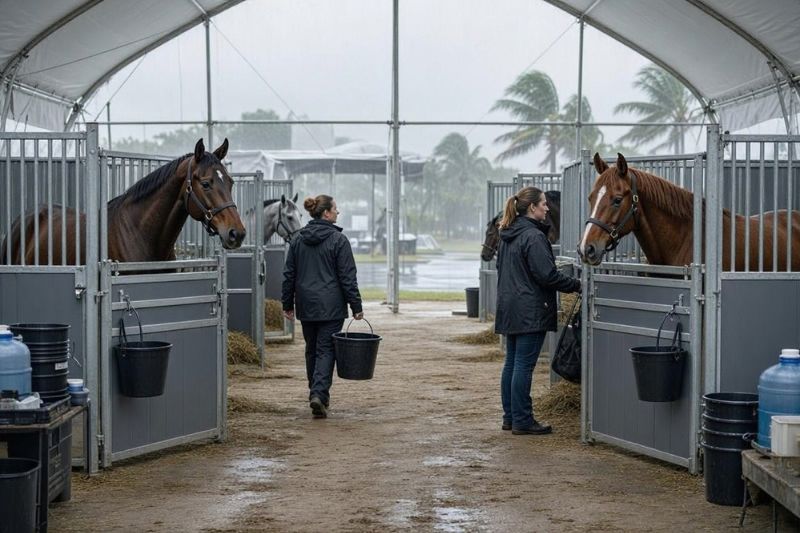
Horses in hurricanes need a plan made well before a storm forms: whether to evacuate or shelter in place, where they will stay, and how you will house them if your barn is damaged afterward. In Florida, that means deciding early, leaving at least 48 hours before hurricane-force winds if you evacuate, and lining up emergency stabling for the days and weeks after the storm.
The University of Florida Large Animal Hospital’s hurricane checklist notes that the Atlantic hurricane season runs from June through November. This guide to hurricane preparedness for horses covers the decision to stay or go, a countdown timeline, emergency stabling options before and after landfall, and how to get horses safely housed again once the storm passes.
This article is general information. Please consult your veterinarian and your county emergency management office for specific guidelines regarding your horses and how to properly care for them during a hurricane.
Stay or Evacuate? How to Decide Before the Storm
The biggest decision comes first, and it should be made at the start of the season, not when a storm is three days out.
The UF/IFAS Extension guide to best management practices for equines in natural disasters recommends having both an evacuation plan and a shelter-in-place plan, since the right choice can change from storm to storm.
If you shelter in place, the barn is not automatically the safest spot. A UF/IFAS checklist for equine care before and after the storm says horses are often best kept at pasture during a storm, and should only be brought inside a structure confirmed to withstand hurricane-force winds. The UF Large Animal Hospital checklist adds that a well-built pole barn or concrete block barn may protect horses from flying debris, but a horse can become trapped if the building collapses.
Before you plan to keep horses on pasture, check it against the points both UF sources raise:
- Good fencing, with no barbed wire or electric fence
- No power lines in or next to the pasture
- No shallow-rooted trees that can fall in high winds
- No loose objects or debris that can blow into the pasture
- Higher ground that will not flood
If your pasture cannot meet these, evacuating or moving horses to a safer pasture is usually the better choice.
Quick decision guide
| Your situation | Likely plan | Why |
| In a coastal area, flood zone, or evacuation zone | Evacuate early | Storm surge and flooding are hard to shelter from in place |
| Safe pasture that passes the checklist, outside flood areas | Shelter in place on pasture | Open pasture limits the risk of building collapse and entrapment |
| Pasture fails one or more checklist points | Evacuate or move to a safer pasture | Trees, power lines, debris, and wire are major injury risks |
| Barn is the only option and its strength is unknown | Evacuate | A horse can be trapped if a building fails |
| No trailer, or more horses than trailer space | Arrange transport now | Waiting until a watch is issued may leave no options |
Hurricane Countdown Timeline for Horse Owners
Hurricane alerts come with lead times built in. According to NOAA, a hurricane watch means tropical-storm-force winds could begin within 48 hours, and a hurricane warning means they are expected within 36 hours. For horse owners, both of those alerts arrive close to the last safe moment to haul.
The UF Large Animal Hospital checklist says evacuation must occur 48 hours before hurricane-force winds reach your area, and that hauling horses is dangerous once wind gusts exceed 40 mph. Plan backward from those limits.
| When | What to do |
| Start of the season | Write your emergency plan, confirm evacuation destinations, update records and identification, check the horse trailer, practice loading, and share the plan with neighbors |
| Storm forms and Florida is in the forecast | Call your destination to confirm space, gather supplies and documents, fuel vehicles |
| Several days before expected impact | Make the go or stay call; if evacuating, prepare to load |
| At least 48 hours before hurricane-force winds | Complete evacuation; secure the barn and property |
| Hurricane watch or warning issued | Finish preparations for horses staying home; do not start a long haul |
| During the storm | Stay safe; do not go out to check horses until conditions allow |
| After the storm | Check horses, water, feed, fences, and structures; arrange emergency stabling if needed |
Before the Storm: Preparing Horses and Property
Identification and records
Lost horses are much easier to return when they are clearly identified. The UF Large Animal Hospital checklist suggests a leather halter with name and farm information sealed in a plastic bag, a waterproof luggage tag with a phone number braided into the tail, and photos of each horse that show identifying marks. The UF/IFAS before-and-after checklist adds that nylon or rope halters should come off, and if a halter is needed, it should be a breakaway style.
Keep these documents in a waterproof container and as digital copies:
- Current Coggins (EIA) test results
- Vaccination and medical records
- Proof of ownership, such as registration papers and photos that help you prove ownership
- Your veterinarian’s contact information and any prescriptions
Talk with your veterinarian about vaccinations before the season starts, and ask whether your evacuation destination needs a health certificate.
Water, feed, and supplies
Utilities and roads may be out for days, and horses need enough water and feed to get through the storm and the week after it. The UF Large Animal Hospital checklist recommends storing 12 to 20 gallons of water per horse per day, and storing at least 72 hours of feed and hay, with seven days being best. The UF/IFAS Extension disaster guide recommends a 3- to 7-day supply of feed, water, and medications for all animals on the property.
Before the storm:
- Fill troughs and lined trash cans with emergency water
- Store hay and grain off the ground, in a dry place, under waterproof covers
- Pack an emergency kit and a first aid kit with bandage materials, adhesive tape, a thermometer, and medications your veterinarian recommends
- Keep spare leather or breakaway halters, non-nylon leads, flashlights with extra batteries, and fence repair supplies together
Securing the barn and property
Wind turns loose objects into hazards. Clear aisles, store jumps, buckets, and equipment, and park trailers and tractors in the open away from trees. If horses will stay out, check fence lines and gates, and keep them away from electric fencing, barbed wire, and power lines.
Emergency Stabling Options Before Landfall
If you evacuate, your horses need somewhere to go, and you need to leave before an evacuation order makes roads crowded. Your local emergency management agency announces evacuation orders and zones, so follow its updates. The UF/IFAS Extension disaster guide says county, state, and private shelter facilities are often announced by local animal officials, suggests contacting your county agricultural extension agent at UF/IFAS Extension for local evacuation center information, and recommends contacting and visiting any shelter ahead of time to understand its policies and capacity.
Common options include:
- A friend’s or partner farm inland, arranged before the season, with a written agreement on stalls, feed, and care
- County or state large-animal shelters, often at fairgrounds or show grounds, which may require current Coggins and your own supplies
- Boarding barns and show facilities outside the forecast area, which can fill quickly when a storm is coming
- Additional stalls at the destination. A host farm or venue taking in extra horses may need temporary stalls to house them safely
When horses from many farms share one facility, disease can spread. Keep your herd together, avoid shared buckets, and ask how the facility separates sick horses. Our guide to USEF isolation rules and isolation stall planning explains how organizers keep isolation stalls apart from the main stabling.
After the Storm: What to Check First
Once it is safe to go outside, work through your horses and property in order. The UF/IFAS before-and-after checklist recommends checking every animal for injury or illness, making sure each horse has food and water, and contacting local animal control if a horse is missing.
- Check every horse. Look closely at eyes, legs, and hooves. Call your veterinarian for wounds, lameness, or signs of colic.
- Check water. If you rely on a well and there was flooding, the same UF/IFAS checklist warns that the water may be contaminated.
- Check feed. Throw out feed or hay that is wet, soiled, or moldy.
- Walk pastures and fences. Wait for floodwater to recede before turning horses back out, and remove debris before horses graze.
- Watch for fallen branches. A University of Kentucky equine toxin report notes that red maple poisoning can occur after storms bring limbs within reach of horses, and that the toxin is in dried or wilted leaves. Remove fallen maple branches from pastures and paddocks.
- Look for downed power lines. Stay away and report them to the utility.
- Document the damage. Photograph barns, fences, trailers, and equipment for insurance claims.
Emergency Stabling After the Storm: When Your Barn Is Damaged
A damaged barn creates a second emergency. Horses may need housing for weeks while roofs, walls, and stalls are repaired, and turning them out on a pasture full of debris is not always an option.
Your options for housing horses during repairs
| Option | Works well when | Watch for |
| Undamaged sections of your own barn | Damage is limited to part of the building | Hidden structural damage; have it inspected before use |
| Boarding at another facility | Nearby barns have space and were not hit | Availability after a regional storm, travel time, cost |
| Pasture with run-in shelter | Pasture and fences are clear and safe | Debris, fallen trees, flies and heat without shade |
| Temporary horse stalls on your property | You need stalls on site during repairs | Ground conditions, drainage, and access for delivery |
Temporary stalls let horses stay home, on their regular routine, while repairs happen. They are also useful for farms and venues taking in evacuated or displaced horses after a storm.
Setting up temporary stalls after a hurricane
Post-storm sites need extra care before stalls go in:
- Choose high, drained ground. Avoid low areas that still hold water, and pick a spot that sheds rain.
- Clear debris. Remove branches, nails, roofing, and metal from the stall area and the delivery route.
- Keep clear of hazards. Stay away from damaged trees, leaning poles, and downed lines.
- Confirm truck access. Fallen trees and soft ground can block the delivery route.
- Ask about permits. Rules for temporary structures can still apply after a disaster. Our guide on whether you need a permit for a barn or portable stalls covers the questions to ask your county.
If you are weighing whether to rebuild or switch to a different setup, our comparison of building a horse barn vs. portable stalls and our guide to horse shelter options can help you plan the long-term fix.
What Most Hurricane Guides for Horse Owners Miss
Most hurricane checklists focus on the days before landfall. These gaps cause the most trouble:
- The 48-hour limit arrives before the warning. A hurricane warning gives about 36 hours before tropical-storm-force winds. If you wait for the warning to start hauling, you are already late.
- Evacuation destinations have limits. Shelters and boarding barns can fill, may require Coggins, and may ask you to bring feed and supplies. Confirm space at the start of the season and again when a storm forms.
- Recovery can take longer than the storm. Barn repairs can take weeks, and horses need safe stabling the whole time.
- Biosecurity matters during displacement. Horses from many farms sharing one facility raise disease risk, so plan for separation.
Emergency and Temporary Horse Stalls From FEI Stabling
FEI Stabling provides temporary horse stalls for storm recovery, emergency shelter, and overflow, for purchase or short- or long-term rental. The team coordinates shipping, helps with permits, and unloads and installs the stalls, and installation is typically completed within hours depending on the number of stalls.
- Portable horse stalls in modular layouts, so you can order the number of stalls you need
- Single-Row Quickstables that can stand alone or attach to an existing barn
- Back-to-Back Quickstables for a compact footprint when you need more stalls in less space
Planning ahead for hurricane season, or need stalls after a storm? Request a quote or contact the FEI Stabling team to talk through your property and timeline.
Frequently Asked Questions
Should horses be left in a barn or a pasture during a hurricane?
UF/IFAS Extension guidance says horses are often best kept at pasture during a storm, and should only be brought inside a structure confirmed to withstand hurricane-force winds. Choose a pasture with good fencing, no barbed wire or electric fence, and no power lines or shallow-rooted trees.
When should I evacuate my horses before a hurricane?
The UF Large Animal Hospital checklist says evacuation must occur 48 hours before hurricane-force winds reach your area, and that hauling horses is dangerous when wind gusts exceed 40 mph. Make the decision early and confirm your destination before you load.
How much water should I store for my horse before a hurricane?
The UF Large Animal Hospital checklist recommends storing 12 to 20 gallons of water per horse per day. Plan for several days, since power and well pumps may be out after the storm.
What documents do I need to evacuate my horse?
Bring a current negative Coggins test, vaccination and medical records, proof of ownership, and your veterinarian’s contact information. Ask your destination whether it requires a health certificate, and keep copies in a waterproof container and on your phone.