
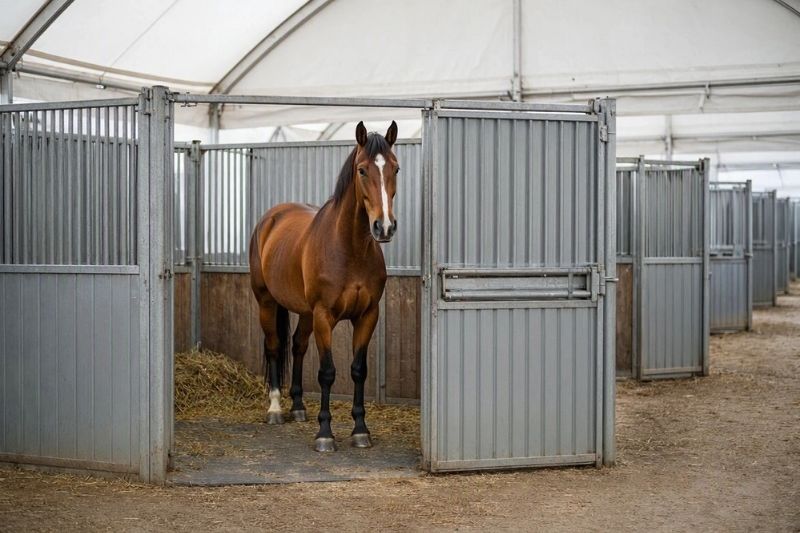
Horse quarantine at a horse show means keeping a sick or possibly exposed horse in isolation stalls, physically apart from competition stabling. For managers of US Equestrian (USEF) licensed competitions with onsite stabling, it is a planning job with a deadline: a written isolation plan filed 14 days before the event, the right number of stalls in the right place, and everything ready before the first horse moves in.
Under USEF rule GR 874, competition managers must upload isolation plans 14 days before the start of the competition, and the plans must be printed and posted on the showgrounds. This guide turns the rule into the four decisions every show manager has to make: whether you need isolation stalls on site, how many, where they go, and what must be ready before move-in.
Decision 1: Do You Need Isolation Stalls on Site?
Start here, because the answer shapes your budget, your site plan, and your vendor orders. The USEF Isolation Plan Template says onsite isolation stabling is required if competition stabling for the event is 10 days or longer, and offsite isolation is permitted for competitions shorter than 10 days.
The USEF Equine Health and Biosecurity Guide adds events with more than 1,000 horses to the onsite list and explains that the 10-day clock starts when horses are allowed into the stabling, not on the first day of competition.
| Your event | Isolation location | What to have in place |
|---|---|---|
| Stabling open 10 days or longer | Onsite | Isolation stalls on the grounds, ready before arrivals |
| More than 1,000 horses | Onsite | Isolation stalls on the grounds, ready before arrivals |
| Stabling open fewer than 10 days | Offsite permitted | An agreement with the offsite facility, named in the plan |
| One-day show, no overnight horses | Exempt, per the USEF guide | A simple plan for a sick horse is still sensible |
Three questions settle it for most managers:
- When do stalls open? Count from the day horses can move in, not from the first class.
- How many horses do you expect? Over 1,000 means onsite, whatever the length.
- Is there a facility that will take a sick horse? The template asks what type of agreement you have with an offsite facility: none, verbal, or written.
If you go offsite, get the agreement in writing and spell out who hauls the horse, who the facility contact is, and how quickly it can accept a horse. A sick horse cannot stay in the main barns while those details get worked out. Some managers of shorter shows choose onsite isolation anyway so the horse never has to leave the grounds.
Decision 2: How Many Isolation Stalls Do You Need?
The USEF Isolation Flow and Checklist sets the count at one percent of the previous year’s horse count, up to a maximum of ten isolation stalls. A partial stall is not a stall, so we suggest rounding up.
| Horses stabled last year | 1% of count | Isolation stalls to plan |
|---|---|---|
| 150 | 1.5 | 2 |
| 400 | 4 | 4 |
| 750 | 7.5 | 8 |
| 1,500 | 15 | 10 (the maximum) |
Two planning notes:
- First-year events have no previous count to work from. Ask USEF competition staff which number to use, and plan from your expected stabling count in the meantime.
- Stalls are not the whole footprint. Leave room in the isolation area for a supply station, a handwashing point, and a clear path for feed delivery and manure removal.
Decision 3: Where Do the Isolation Stalls Go?
Pick the isolation site before you lay out the main barns. USEF’s guidance for setting up an isolation area says to place it as far from the showing horses as possible, keep human, vehicle, and animal traffic from passing through it, and separate it from the rest of the grounds with a physical barrier. The checklist adds that isolation stabling must be in a separate structure from competition stabling.
Use this site checklist when you walk the grounds:
- A separate barn or a stand-alone block of stalls, not the end of a competition aisle
- Away from warm-up rings, main aisles, and the routes horses, people, and vehicles use every day
- Its own access lane, so a veterinarian or trailer can reach it without crossing the main stabling
- Water and electrical supply close by, which the plan template asks about
- Good drainage and room for perimeter fencing or rope and restricted-access signs
The stalls themselves have a clear bar to meet. The checklist asks whether all isolation stalls have at least 3 solid walls a minimum of 8 ft tall. The USEF guide explains why: solid-wall stalls prevent horse-to-horse contact, while half-bar stalls allow nose-to-nose contact. Our guide to stall dividers covers the partition options in more detail. Whatever system you use, measure the walls and write the height into the plan.
Decision 4: What Must Be Ready Before Move-In?
The checklist asks whether isolation stalls are immediately available. A plan that says “we will set up stalls if needed” does not meet that. Work back from the day the barns open.
At least 14 days before the competition
Upload the plan. The USEF Onsite Isolation Stabling Requirements list what it must include:
- A map showing where isolation stabling sits
- A description of the stalls, including height, surface type, floor type, and whether they are permanent or temporary
- The disinfectant product and protocol
- A named isolation contact
- Fly, mosquito, and rodent control measures
If isolation is offsite, have the facility agreement signed by this date too. If you are renting stalls for isolation, confirm the order, the configuration, and the wall height with your stall provider before you file, since the plan has to describe them.
During setup, before stabling opens
- Stalls installed, measured, cleaned, and disinfected (the checklist asks for cleaning and disinfection before each event)
- Perimeter barrier up and restricted-access signs posted; the AAEP General Biosecurity Guidelines recommend signage in English and Spanish
- Dedicated stall cleaning and feeding equipment in place, used only in isolation
- A supply station stocked with disinfectant footbaths, gloves and protective gowns, a thermometer for each horse, and a temperature log for each stall door
- A handwashing or sanitizing station; a UC Davis Center for Equine Health guide, How to Set Up a Disease Isolation Unit at a Farm or Horse Show, calls for washing hands for 60 seconds
- Fly, mosquito, and rodent control running
On move-in day
- The plan printed and posted on the showgrounds, as GR 874 requires
- The isolation contact and a backup on site, with the competition veterinarian’s number
- Barn managers and grooms briefed on the fever threshold and how to report one
- Arrival checks matched to USEF’s biosecurity measures, which describe exhibitors declaring no clinical signs and a temperature below 101.5°F for 3 to 5 days before the event
When a Horse Runs a Fever: Putting the Plan to Work
The USEF Equine Health and Biosecurity Guide states that a temperature over 101.5°F is considered a fever, recommends taking temperatures twice daily, 12 hours apart, and treats horses on firocoxib as febrile above 100.5°F. The USEF fever flyer tells trainers to notify the competition veterinarian and competition management as soon as possible, and no later than two hours after detecting an unexplained fever.
Once a horse is in isolation, the care order matters. The AAEP guidelines say to handle healthy horses first, then exposed horses, and sick horses last. Post that order at the isolation entry so every groom and volunteer sees it. If a case is confirmed, state animal health officials may place movement restrictions on affected barns, and your competition veterinarian decides what testing a horse needs before it leaves isolation.
What Most Isolation Plans Miss
Managers who have filed a plan before tend to get the paperwork right. The gaps usually show up on the ground:
- Stalls that exist only on paper. If the stalls are not standing and clean when barns open, they are not immediately available.
- Unchecked wall height. The 8 ft solid-wall requirement applies to the stalls you actually use. Measure them.
- No backup contact. Name a second person who knows where the supplies, logs, and keys are.
- Shared tools. One borrowed pitchfork can carry disease back into the main barns. Label isolation equipment in a bright color.
- A plan nobody can see. Print it, post it, and brief the barn staff on it.
Can Temporary Stalls Be Used for Isolation?
Yes. USEF’s onsite requirements ask whether isolation stalls are permanent or temporary, so either can work. Temporary stalls let you put isolation exactly where the site plan needs it rather than wherever an old barn happens to stand.
Our piece on why temporary stabling suits equestrian events explains the layout flexibility, and our guide to setting up stabling for a horse show covers the wider site plan that isolation fits into.
For cleaning between events, see how to disinfect a horse stall, and for the pest control your plan must describe, see fly and pest control in the barn.
Planning Isolation Stabling With FEI Stabling
FEI Stabling provides temporary horse stalls for horse shows, with the team coordinating shipping, helping with permits, and unloading at your site. That makes it practical to stand up a small, self-contained isolation block alongside the main competition barns.
- Barn Style stalls can be configured as a veterinary block, with nail-free construction and kick-through resistant partitions.
- Single-Row Quickstables are modular, so you can order exactly the number of stalls your isolation count calls for.
- Back-to-Back Quickstables have 7.5 ft partitions and an efficient layout suited to the main competition barns. For isolation, choose a configuration that meets the 8 ft solid-wall requirement.
Share your isolation plan with the team early and confirm the wall height of the configuration you choose before you file. All portable horse stall options are available to rent or buy.
Ready to plan isolation stabling for your next show? Request a quote or contact the FEI Stabling team to talk through your layout.
Frequently Asked Questions
Is an isolation plan required for every USEF show?
USEF requires a written isolation plan for licensed competitions with onsite stabling, uploaded 14 days before the competition and posted on the grounds. Events with stabling of 10 days or longer, or more than 1,000 horses, need isolation stalls onsite. Shorter events may use an offsite facility.
How many isolation stalls does a horse show need?
USEF sets the number at one percent of the previous year’s horse count, with a maximum of ten isolation stalls. A show that stabled 300 horses last year would plan for 3 stalls, and larger shows stop at 10.
Where should isolation stalls be placed at a show?
In a separate structure from competition stabling, as far from the showing horses as possible, with no human, vehicle, or horse traffic passing through. A physical barrier and restricted-access signs mark the boundary.
When do isolation stalls need to be set up?
Before horses arrive. USEF’s checklist asks whether isolation stalls are immediately available, so they should be installed, cleaned, disinfected, and stocked before the stabling opens.
What temperature is a fever in a horse at a USEF show?
USEF considers a temperature over 101.5°F a fever, or above 100.5°F for horses on firocoxib. An unexplained fever must be reported to the competition veterinarian and management within two hours of detection.
Can portable stalls meet USEF isolation requirements?
Yes, USEF allows isolation stalls to be permanent or temporary. What matters is the setup: a separate structure away from traffic, restricted access, dedicated equipment, and at least 3 solid walls a minimum of 8 ft tall. Confirm the wall height of any stall system before you file the plan.
This article is general information, not veterinary advice. Work with your competition veterinarian and your state animal health officials on any suspected disease case.