
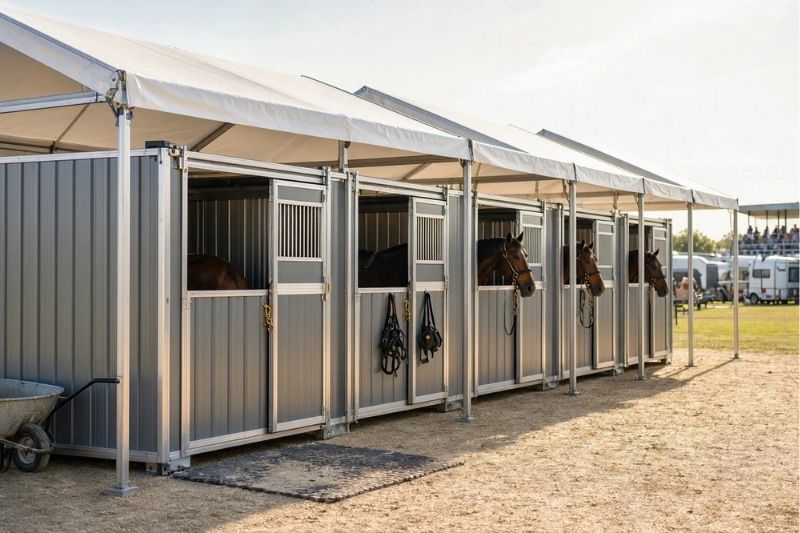
Do you need a permit for a barn? For a permanent barn, usually yes, unless it qualifies as an exempt farm building on agricultural land. For portable horse stalls, it depends on how long they stay, where they sit, and the land’s status. Either way, the county makes the call, so the question to settle before you order stalls is simple: will the county need to approve this?
In Florida, Florida Statutes section 604.50 exempts qualifying nonresidential farm buildings from the Florida Building Code and from county or municipal codes and fees, except for floodplain management rules. This guide explains how permits usually work for permanent barns compared with portable stalls, and how to get a clear local answer well before delivery day.
This article is general information, not legal advice. Rules differ by county and city, so confirm your project with your local building department before you build or set up stalls.
Will the County Need to Approve Your Stalls?
Most answers come down to four facts about your project. Have them ready before you call anyone:
- Permanent or portable. A barn on a foundation is reviewed as a building. Portable stalls may fall under temporary structure rules or a farm building exemption.
- How long the stalls will stay. Model building code rules for temporary structures apply to structures up for less than 180 days.
- The land’s status. Agricultural classification can exempt a farm building from the building code. A residential lot usually cannot.
- The site itself. Flood zones, setbacks, and electrical hookups can require review even when the structure is exempt.
How Permits Usually Work for a Permanent Barn
On a residential lot without agricultural status, a barn is generally treated as an accessory structure, like a detached garage. Expect a building permit, a site plan, plan review, and inspections, and expect zoning to decide whether horses are allowed at all.
On farm land, the picture changes. Section 604.50 defines a nonresidential farm building as any temporary or permanent building or support structure used primarily for agricultural purposes, on land that is part of a farm operation or classified as agricultural land, and not intended as a residential dwelling. The statute lists barns among its examples.
The building only qualifies if the land does. Florida Statutes section 193.461 defines bona fide agricultural purposes as good faith commercial agricultural use of the land. It lists livestock among agricultural uses but does not name horses on their own, and a backyard horse kept for pleasure is not the same as a commercial operation. Counties also want proof. Hillsborough County requires the property to be designated as agricultural land by the property appraiser, and Hernando County asks for a signed, notarized nonresidential farm building affidavit plus agricultural classification documentation.
Even an exempt barn can still need approval for parts of the project:
- Flood zones. FEMA’s floodplain management bulletin on agricultural structures states that permits are required for agricultural structures in regulated floodplains. Hernando’s form says no exemption will be granted for any structure in a FEMA-designated flood zone.
- Zoning and setbacks. A Florida Attorney General opinion concluded that a county may still require a zoning compliance permit for a farm building and that setback requirements would apply.
- Electrical, plumbing, and gas. Counties disagree. The Okaloosa County farm building form says the exemption does not cover these permits, while the Manatee County request form says they are not required for a qualifying building. Either way, use a licensed electrician.
- Public use. A UF/IFAS Extension guide explains that fire safety rules under Florida Administrative Code rule 69A-67 apply to farm buildings used for agritourism, such as clinics or events.
How Permits Usually Work for Portable Horse Stalls
Portable stalls are not automatically permit-free, but the path is often lighter than for a permanent barn. Three rules decide most cases.
The farm building exemption can cover them
Section 604.50 is written to cover temporary as well as permanent structures. A portable stall system on qualifying farm land, used for the farm operation, is evaluated under the same definition as a built barn.
Temporary structure rules depend on time
Without an exemption, the clock matters. The International Code Council’s summary of 2021 IBC changes states that the temporary structure provisions apply to structures erected for less than 180 days, and that structures erected for longer must comply with the rest of the code. Florida applies its own version through the Florida Building Code, and local building officials decide how a given project is classified. Stalls you plan to keep long term are likely to be reviewed more like a permanent structure.
The site still matters
Placement, setbacks, flood zones, and any electrical work for lighting can all trigger review, even for stalls that sit on the ground without a foundation. For event stabling, the venue or event organizer usually coordinates permits, fire lanes, and site plans with the local jurisdiction.
Permanent Barn vs. Portable Stalls: Permitting Side by Side
| Question | Permanent barn | Portable stalls |
|---|---|---|
| Covered by Florida’s farm building exemption? | Yes, if it meets s. 604.50 | Yes, if it meets s. 604.50; the definition covers temporary structures |
| Without agricultural status | Building permit usually required | Building or temporary structure permit often required |
| Time limit | None once permitted or exempt | Temporary structure rules apply to structures up for less than 180 days |
| Floodplain rules | Apply | Apply |
| Zoning and setbacks | Apply | Usually apply; ask about placement |
| Electrical work | Permit depends on county | Permit depends on county |
| Foundation and site work | Typically significant | Typically minimal |
For the trade-offs beyond permits, see our comparison of temporary vs. permanent stalls and our breakdown of building a horse barn vs. portable stalls on cost.
Common Situations: Which Rules Apply?
- A working horse farm adding stalls. With agricultural classification, the farm building exemption is likely in play. Still check flood zone, setbacks, and whether the county wants an affidavit or an electrical permit.
- A backyard horse on a residential lot. Start with zoning to confirm horses are allowed, then the building department. A permit is likely for a barn and often for stalls.
- Stalls during a barn build or rebuild. Short-term stalls may fall under temporary structure rules. Ask how the county handles them and for how long.
- Event stabling for a show or clinic. The venue usually handles temporary structure permits and site plans. Our guide to setting up stabling for a horse show covers the layout side.
How to Find Out Locally Before Delivery Day
The worst time to learn that stalls need approval is when the truck is in the driveway. Work through these steps as soon as you are seriously considering an order.
- Check the parcel’s status. Ask the county property appraiser whether the land has agricultural classification. That one answer tells you whether the farm building exemption is even possible.
- Check the flood zone. Ask the county floodplain office or building department whether any part of the site is in a FEMA flood zone. If it is, plan on a permit.
- Call zoning. Confirm horses are allowed and ask what setbacks apply to a structure that houses livestock.
- Call the building department with specifics. Describe the number and size of stalls, the stall system (your stall provider can send specifications), whether the stalls are permanent or temporary, how long they will stay, and whether you will add electrical.
- Ask the right questions. Does my parcel qualify for the farm building exemption? Do you need an affidavit? How do you treat portable stalls, and is there a time limit? Do I need electrical or other trade permits? Are there extra rules if I host lessons or events?
- Get the answer in writing. An email from the building department, an exemption letter, or a stamped affidavit protects you later. Lenders, insurers, and buyers may ask for it.
- Set the delivery date around the answer. If a permit is needed, expect to submit an application with a site plan showing property lines, easements, and distances to other structures. Allow time for review before you confirm delivery, and share the approval with your stall provider.
In Marion County, for example, the Building Safety Department handles permits and inspections under the Florida Building Code, 8th edition, and can be reached at 352-438-2400.
What Most Barn Permit Guides Miss
- Exempt does not mean unregulated. The farm building exemption covers the building code, not floodplain rules, and counties may still apply zoning.
- The land qualifies, not the horse. Pleasure horses alone may not establish agricultural status.
- Portable is not the same as permit-free. Time on site, placement, and electrical hookups can still bring stalls under review.
- Changing the use changes the rules. Adding living space, running a business from the building, or hosting the public can pull a project back under permits and fire codes.
Flexible Horse Stalls From FEI Stabling
When a permanent barn is not the right fit yet, or you need stalls while you work through the permit process, FEI Stabling offers portable horse stalls for purchase or for short- or long-term rental, with the modular design letting you order exactly the stalls you need.
- Temporary horse stalls for shows, emergency stabling, and overflow, with the team coordinating shipping, helping with permits, and unloading at your site
- Portable horse stalls for sale for farms that want a long-term solution with minimal site work
- Single-Row Quickstables with a curved Clearspan roof, as a standalone structure or an addition to an existing barn
- Barn Style stalls with roofs and aisleways for larger layouts
Still deciding what your horses need? Our guide to whether your horse needs a barn compares shelter options, and our horse barn design and layout guide helps you plan the space.
Talk through your property, timeline, and permit questions with the team: request a quote or contact FEI Stabling.
Frequently Asked Questions
Do I need a permit to build a barn on agricultural land in Florida?
Often not for the structure itself. Section 604.50 exempts nonresidential farm buildings on land used for bona fide agricultural purposes from the Florida Building Code and local building fees. Floodplain rules still apply, and your county may still require zoning approval, an affidavit, or trade permits.
Do you need a permit to build horse stalls?
It depends on the property and the type of stall. On qualifying farm land, stalls in an exempt farm building may not need a building permit. On a residential lot without agricultural status, new stalls or a stall barn usually need a permit.
Do you need a permit for a portable building?
Often, yes, unless an exemption applies. Florida’s farm building exemption covers temporary structures on qualifying farm land. Elsewhere, temporary structure rules apply to structures up for less than 180 days, and many jurisdictions require a permit for them.
How far ahead should I check permits before stalls are delivered?
As soon as you are seriously considering an order. If no permit is needed, a few calls settle it. If one is needed, you will need time to prepare a site plan and wait for review, so confirm the answer before you lock in a delivery date.
What happens if I set up a barn or stalls without a required permit?
The county can require after-the-fact permits, inspections, or changes. It can also issue stop work orders and fines, and unpermitted structures can complicate insurance claims and property sales. Written confirmation before you start is the simplest protection.