
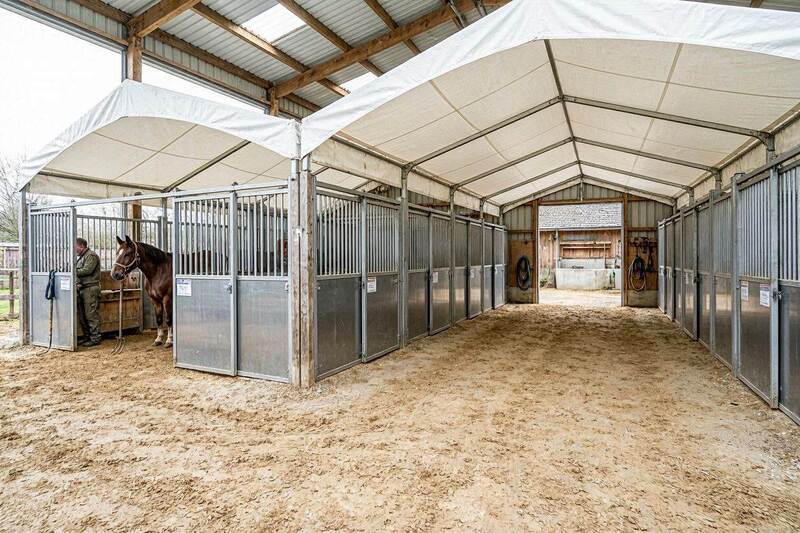
A well designed horse barn does much more than hold stalls. It shapes horse health, staff efficiency, fire safety, sanitation, and the day to day experience of everyone who uses the space.
If you are planning a new build, a renovation, or temporary stabling for an event, focus on these five decisions first:
- Put ventilation ahead of looks
- Size stalls and aisles for real horse movement, not just minimum fit
- Separate hay, bedding, and equipment storage when possible
- Design traffic flow to reduce stress, mess, and wasted steps
- Choose stall systems that can adapt as your needs change
Those priorities are not just preference. University extension resources consistently emphasize fresh air, adequate space, flexibility, and reduced fire risk as core parts of sound barn planning. Barns should provide fresh air, a dry bedded area, and enough space for both horses and handlers, while also encouraging single story, clear span construction and separate storage for hay and bedding to reduce fire hazards. Ventilation is also a major health factor in horse housing.
Start with the barn’s job, not the blueprint
Before you choose a roofline or stall front, define what the barn needs to do every day.
Ask yourself:
- Is this for private use, boarding, training, breeding, or events?
- Will horses be housed overnight, long term, or only during shows?
- Do you need wash stalls, vet space, quarantine space, or tack up areas?
- Will equipment move through the aisle?
- Do you need a layout that can grow over time?
This matters because good barn design is functional first. According to Extension Horses, the outside dimensions of the structure need to support the interior plan without shrinking essential horse space, and minimum dimensions often fall short of what owners actually need for safe, efficient care.
Ventilation is the design decision that affects horses most
Horse barns need steady airflow without creating a constant draft on the horse. That balance is one of the most important parts of barn design because poor air quality can contribute to respiratory irritation and inflammation.
Michigan State University cites research showing young horses housed indoors had a higher incidence of airway inflammation than similar horses kept on pasture, and it gives a practical rule of thumb of about one foot of ridge ventilation per horse or stall. Adding a small adjustable window in each box stall can improve both light and ventilation. The University of Minnesota recommends roof insulation in naturally ventilated barns to reduce condensation in winter and heat load in summer.
For most barns, that means planning for:
- Open, consistent air movement at the eaves and ridge
- Stall windows that can be adjusted safely
- Natural light without trapping heat
- Enough ceiling height for warm, stale air to rise
- Fans used to improve comfort, not as a substitute for fresh air exchange
This is one area where FEI Stabling stands out. Its Barn Style stalls and Back to Back Quickstables are built with a continuous open eave design intended to support natural airflow, an important advantage for temporary and event based setups where air quality can suffer if layout is an afterthought.
Get stall size and aisle width right the first time
A barn can look impressive on paper and still feel cramped once horses, handlers, tack trunks, wheelbarrows, and equipment are all in motion.
A practical baseline for many full sized horses is a 12 by 12 stall, with larger spaces for bigger horses, extended stalling, or special uses. Penn State Extension’s horse stall design resource states that stall size depends on horse size and how much time the horse spends stalled. Additionally, a foaling stall should be at least twice the size of a single stall for that horse.
As you lay out the interior, plan for:
- Standard stalls sized for the horses you actually own or serve
- At least one oversized stall for foaling, recovery, or a larger horse
- Wide aisles that allow safe passing and easier equipment use
- Doorways that open smoothly and do not create pinch points
- A layout that keeps nervous horses from crowding each other
For event facilities or flexible properties, modular design can make this much easier. FEI Stabling’s Single Row Quick stables allow customers to order the exact number of stalls needed, while Barn Style stalls can be configured for veterinary blocks or wash areas. That flexibility helps owners avoid forcing one permanent layout to solve every future need.
Design the layout around daily movement
The best horse barn layouts reduce friction. Feed should move efficiently. Horses should move calmly. Dirty tasks should stay contained. Clean tasks should not cross through them.
A smart layout often includes:
- Feed and tack positioned for quick access
- Wash and grooming areas away from congested stall fronts
- Manure handling routes that do not cross horse traffic
- Dedicated storage for first aid, buckets, and daily supplies
- Space to isolate a horse when needed
Extension Horses emphasizes that interior planning must account for the actual usable space inside the building, not just the outside shell. That sounds simple, but it is one of the biggest reasons barns feel inefficient after they are built.
If your operation changes often, such as showgrounds, seasonal circuits, or expanding private facilities, portability becomes a layout advantage rather than a compromise. FEI Stabling’s team handles site assessment through installation, which is especially valuable when layout decisions must work in real conditions, not just on a sketch. The company is also led by Olympian Clayton Fredericks, bringing hands-on equestrian experience into the planning process.
Plan for fire safety from day one
Fire safety should shape layout decisions early, not after construction.
It’s important to have separate buildings for hay, feed, and bedding when possible because that reduces fire hazards. Space heaters are the number one cause of fires. An AAEP paper published through IVIS reports that many barn fires become fully involved within five to seven minutes of ignition, which leaves very little time for response.
That makes these choices especially important:
- Keep hay and bedding storage separate if possible
- Use safe electrical design and inspect wiring regularly
- Avoid relying on portable heaters in horse areas
- Make exits obvious, wide, and easy to access
- Keep emergency tools and extinguishers clearly located
- Create an evacuation plan and practice it
Fire safety also overlaps with stall construction. FEI Stabling emphasizes nail free construction, splinter resistant partitions, and fast installation across its portable stall systems. Those details matter because safer materials and cleaner installation help reduce some common injury and maintenance risks in both temporary and long term use.
Choose materials that are safer, cleaner, and easier to maintain
Horse barn design is never only about dimensions. Materials change how the barn performs over time.
Look for stall components and finishes that offer:
- Smooth surfaces that are easier to disinfect
- Durable partitions that resist splintering
- Secure latches that do not protrude dangerously
- Flooring that supports traction and drainage
- Components that stand up to repeated setup and teardown if the barn is portable
This is another area where FEI Stabling brings a different level of practicality. Its Back to Back Quickstables use galvanized steel frames and HDPE partitions, while its Barn Style stalls highlight nail free construction, kick through resistant partitions, and optional accessories such as lighting and anti weave grills. For owners and organizers who need stabling that is both horse centered and operationally efficient, that combination is hard to ignore.
Why flexible stabling is becoming a smarter long term choice
Many owners still think of portable stalls as a short term solution only. In reality, modular stabling can solve layout challenges that permanent barns often struggle with.
It can help when you need to:
- Expand capacity for a season
- Add quarantine or veterinary space
- Rework traffic flow for an event
- Test a layout before committing to construction
- Add horse housing without building an entirely new barn
FEI Stabling is built around that kind of flexibility. The company offers rentals and purchases, customization, delivery, and installation, and practical resources on event stabling, stall quality, flooring, and airflow. That educational approach fits what horse owners and facility managers actually need: sound guidance first, then a solution that fits the job.
Build a barn that works every day
The best horse barn design is not the one with the most features. It is the one that keeps horses healthier, makes care easier, and adapts as your needs change.
When in doubt, return to the essentials:
- Prioritize airflow
- Give horses real space
- Simplify movement
- Reduce fire risk
- Invest in materials and layouts that stay useful over time
If you are planning a new setup or rethinking an existing one, FEI Stabling offers a useful middle ground between custom planning and practical execution. You can explore portable horse stall options, learn more about FEI Stabling, or contact the team to discuss a layout that fits your horses, property, or event.