
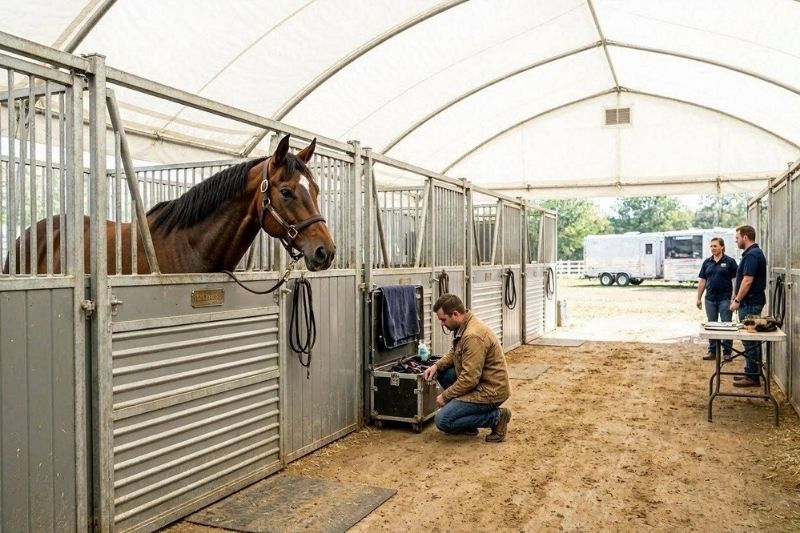
If you want the short answer first, most horses do not need a full barn to stay healthy and comfortable year round. They do need shelter that matches their climate, turnout routine, health status, and management needs. The American Association of Equine Practitioners states that horses should be protected from injurious heat, cold, and severe weather, and the Merck Veterinary Manual notes that horses generally do well in cold weather if they stay dry and clean. In practice, that means a run-in shelter may be enough for some horses, while others benefit from stalls, a barn, or a flexible portable setup that gives you more control.
The best choice usually comes down to five questions:
- Does your horse need close monitoring, individual feeding, or isolation?
- Is your climate hot, wet, windy, snowy, or highly variable?
- Does your property need permanent housing or adaptable shelter?
- Are you managing one horse, a herd, or a short term event setup?
- Can you provide good airflow, dry footing, and safe separation no matter which option you choose?
Answer those honestly, and the right shelter option becomes much clearer.
What horses actually need from shelter
A horse shelter should do more than block rain. It should help keep horses dry, offer shade in hot weather, reduce wind exposure, support clean footing, and fit normal horse behavior. The AAEP emphasizes an environment that respects the horse’s biology and behavior, while Merck notes that summer housing should provide shady areas and winter housing should keep horses dry with good ventilation if they are indoors. Penn State Extension also advises providing a dry sheltered area in cold, wet weather and notes that shelter can be a three sided run-in, a barn, or even a dense tree line in some settings.
That last point matters. “Shelter” is not one thing. It is a category. For one horse on pasture in a moderate climate, a run-in may be all that is needed. For a clipped show horse, a senior horse, a horse on stall rest, or a horse at a busy competition venue, more structured stabling often makes better sense. Cold weather nutrition guidance in the Merck Veterinary Manual points out that cold increases energy needs, especially for horses lacking adequate outdoor shelter.
Run-in shelters: simple, affordable, and often enough
A run-in shelter is usually the most practical option for horses that live outside full time or spend long hours on turnout. It offers shade, a windbreak, and a dry refuge without confining the horse. Veterinary sources cited by The Horse have long noted that run-in sheds can offer better ventilation and less dust accumulation than a conventional enclosed barn, which can be a real advantage for respiratory health.
A run-in can work especially well when:
- Your horse is healthy and acclimated to outdoor living
- You have enough space for movement and herd dynamics
- Your pasture drains well
- You are not dealing with intensive medical, feeding, or training needs
- Your local weather is manageable with shade and a windbreak
Still, run-ins have limits. Lower ranking horses may be pushed away from shelter by more dominant horses. Wet, muddy entrances can become a hoof and sanitation problem. And if a horse needs medications, controlled feed intake, or separation from others, a run-in can become inconvenient fast. Merck also notes that stalls and partitions help prevent direct contact between horses, which matters when biosecurity is a concern.
Full barns and traditional stalls: control, protection, and more daily management
A full barn gives you the greatest level of control. You can monitor appetite, water intake, manure, injuries, and behavior more closely. Indoor stalls also make it easier to separate horses, manage special diets, protect tack and feed, and care for horses recovering from illness or injury. Merck specifically recommends well ventilated, easy to clean indoor areas with nonslip floors and walls that keep horses from touching one another.
That control comes with tradeoffs. Poorly ventilated barns can trap dust, moisture, and airborne irritants. The University of Minnesota Extension stresses that barns need regular air exchange, and Merck warns that barn dust contains irritants from bedding, manure, hay, hair, and other particles. Confinement can also create behavioral issues. Many behavior problems are associated with confinement, and increased pasture time, exercise, and social contact are often part of the solution.
In other words, barns are excellent tools, but they work best when paired with turnout, ventilation, and thoughtful management.
Portable stalls: the middle ground more owners and facilities need
This is where many horse owners, event managers, and facility operators find the smartest answer. Portable stalls bridge the gap between open shelter and a permanent barn. They give you the structure, separation, and monitoring benefits of stabling, without requiring a new permanent building.
That matters in real life. You may need overflow capacity during show season, a temporary setup during a barn renovation, a clean quarantine area, or a safer way to house horses at clinics and competitions. FEI Stabling is built around that need. The company is led by Olympian Clayton Fredericks and handles the full process from site assessment through installation, which is a meaningful difference from simply buying panels and figuring out the rest on your own.
FEI Stabling also focuses on details that directly affect horse comfort and safety. Our Barn Style Stalls feature nail free construction, kick through resistant partitions, and a continuous open eave design for natural airflow. FEI Stabling’s Back to Back Quickstables add 7.5 foot partitions to reduce horse to horse contact, while Single Row Quickstables can stand alone or extend an existing barn with modular flexibility. Those design choices align with what veterinary guidance emphasizes about ventilation, separation, and safety.
Which shelter option fits your situation?
Choose a run-in shelter if:
- Your horse lives primarily outdoors
- Your herd gets along well
- You want maximum freedom of movement
- Your climate is moderate or your turnout area already offers solid weather protection
- You do not need frequent individual feeding or close medical monitoring
Choose a traditional barn if:
- Your horse needs daily hands on management
- You need secure feed, tack, and supplies on site
- You routinely deal with severe weather
- You have horses that need separate turnout and stabling plans
- You can provide strong ventilation and regular turnout
Choose portable stalls if:
- You need a temporary or seasonal stabling solution
- Your facility hosts events, clinics, or overflow horses
- You want barn style control without building a full permanent barn
- You need a fast, scalable setup with professional installation
- You want adaptable layouts for wash stalls, veterinary areas, or added capacity
Common mistakes horse owners make with shelter
The biggest mistakes are usually management issues, not shelter type issues.
- Assuming a barn is automatically better, even if airflow is poor
- Assuming a run-in is enough, even when one horse gets excluded from it
- Ignoring mud, drainage, and footing around entrances
- Overlooking shade and heat stress in summer
- Using confinement without enough turnout and stimulation
- Choosing cheap materials that splinter, trap moisture, or create unsafe edges
This is why design matters as much as category. A simple shelter that stays dry and safe can outperform a badly managed barn. A modular stall system with good ventilation and thoughtful layout can outperform a rushed temporary setup that ignores horse behavior and biosecurity.
So, does your horse need a barn?
Sometimes yes. Often no. What every horse needs is the right level of shelter for its health, workload, environment, and daily routine.
If your horse thrives outdoors and has dependable access to shade, dryness, and a windbreak, a run-in may be enough. If your horse needs closer care, better separation, or protection during travel, events, or rehabilitation, stalls may be the better answer.
And if you need barn level function without a permanent build, FEI Stabling offers a practical path with portable horse stall options, modular single row setups, and event ready back to back stalls supported by consultation and installation from an experienced equine team. For more planning guidance, the FEI Stabling blog and contact page are good places to start.