If you need more horse housing, the biggest question is usually not can you add stalls. It is what kind of investment makes sense right now.
Here is the short answer.
A permanent horse barn usually makes the most sense when you need year round stabling on your own property, want to add long term asset value, and have the budget for site work, utilities, permits, and ongoing maintenance.
Portable stalls usually make more sense when you need flexibility, faster setup, lower upfront commitment, seasonal overflow capacity, event stabling, quarantine space, or a way to expand without locking yourself into a full construction project.
That decision matters because the true cost of a barn is not just the shell. It is the slab, drainage, electrical, ventilation, doors, stall fronts, labor, permitting, and the time it takes to get the building ready for horses. Portable systems can reduce many of those variables while still delivering safe, comfortable, professional stabling when designed well.
For owners, trainers, and event organizers who need a practical answer fast, this is the best rule of thumb:
- Choose a permanent barn when your need is stable, predictable, and long term
- Choose portable stalls when your needs change by season, event schedule, horse count, or site layout
What a permanent horse barn really costs
A permanent barn can be an excellent investment, but it is rarely a simple one.
Many cost articles focus on square footage alone. In reality, horse facilities are shaped by welfare, airflow, labor efficiency, and fire safety, not just size. According to Penn State Extension’s horse stall design guide, a 12 foot by 12 foot stall is the standard recommendation for a 1,000 pound horse. That means the footprint adds up quickly once you include aisle space, tack storage, feed areas, wash space, and circulation.
Your total barn budget often includes:
- Site preparation and grading
- Concrete or other foundation work
- Drainage and runoff management
- Framing and roofing
- Interior stall packages and partitions
- Electrical and lighting
- Water lines and plumbing
- Ventilation features
- Doors, windows, and hardware
- Labor, permitting, and inspections
There is also the cost of getting the design right. Penn State Extension’s stable ventilation guidance notes that each stall should have direct access to fresh air openings year round and that warm weather openings should equal about 5 to 10 percent of stall floor area. That is a design issue, not a decorative upgrade, and it can affect both build cost and horse comfort.
So while a permanent barn can be the right move, the budget almost always grows beyond the first number you see in a general estimate.
Where portable stalls can save money
Portable stalls shift the conversation from full building cost to functional stabling cost.
Instead of financing an entire structure, you can often pay for only what you need right now:
- The number of stalls you actually need
- The rental period or purchase scope that fits the job
- Delivery and installation instead of a long build cycle
- Layout flexibility instead of a permanent footprint
That is especially useful for:
- Horse shows and equestrian events
- Seasonal influxes
- Temporary quarantine or isolation space
- Barn renovations
- Training centers with fluctuating numbers
- Private properties testing a layout before building permanently
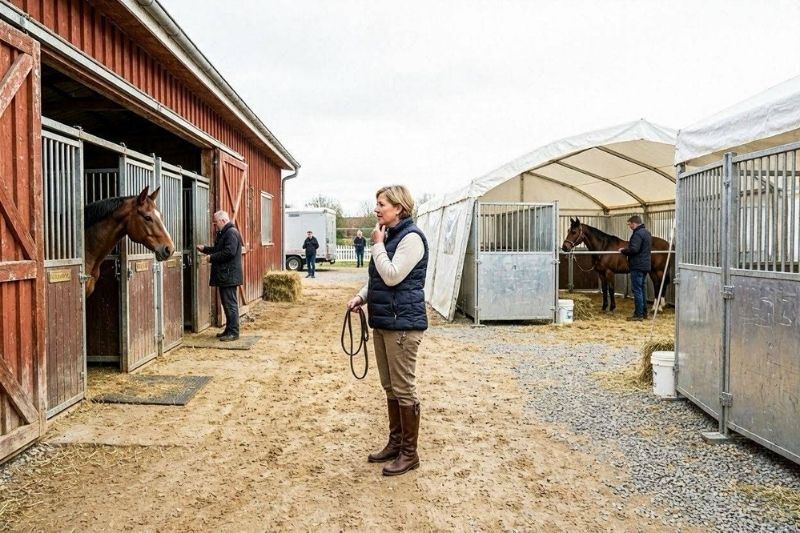
This is where FEI Stabling stands out. FEI offers portable horse stalls for rent or purchase with consultation, delivery, and installation built into the process. Our Single Row Quickstables can be used as stand alone units or added to an existing barn, and the modular design allows customers to order the exact number of stalls needed. That is a meaningful cost advantage when your horse count or site plan may change.
When building a barn is still the better option
Portable does not automatically mean better. A permanent barn can be the smarter investment when:
- You own the property and plan to stable horses there for many years
- You need integrated tack, feed, office, wash, and utility areas
- Local weather makes a fully enclosed, permanent system more practical
- You want a custom facility designed around daily operations
- you’re improving property value for a long term equine business
A barn can also be more economical over time if you know your needs will remain consistent and the building will be used heavily year after year.
In other words, permanent barns win on permanence. Portable stalls win on agility.
The safety and comfort factors that should shape your choice
Cost matters, but horse welfare should lead the decision.
According to Penn State Extension, stall design should support safe movement for both horse and handler, and electrical wiring should be protected in conduit because rodents can damage exposed wiring and create a fire hazard. Penn State’s fire safety guidance also emphasizes how barn design affects fire behavior and evacuation planning.
Ventilation is just as important. Poor airflow can trap moisture, dust, and ammonia. University of Minnesota Extension explains that horse barns need air exchange to remove moisture, control condensation, and maintain air quality.
That means your decision should not be based on “permanent versus temporary” alone. It should be based on whether the system gives horses:
- Adequate stall space
- Reliable airflow
- Safe partitions and doors
- Secure separation where needed
- Easy cleaning and disinfection
- Calm, predictable handling conditions
Well designed portable systems can perform very well on those points. FEI’s Barn Style Stalls feature nail free construction, kick through resistant partitions, and a continuous open eave design for airflow. Our Back to Back Quickstables use 7.5 foot high partitions to reduce horse to horse contact and HDPE partitions that resist splintering. Those details matter because they address real operational and welfare concerns, not just appearance.
Portable stalls are often the smarter biosecurity choice for events
For equestrian events, temporary stabling is not just a convenience. It can be part of a better disease control strategy.
The American Association of Equine Practitioners note that infectious disease risks increase in places where horses move on and off the property frequently, including event facilities and stables. Utah State University’s equine guidance recommends designated stall management, cleaning, disinfection, and isolation planning when horses are co-mingled.
Portable stalls can support that effort by making it easier to:
- Create dedicated event layouts
- Add temporary isolation zones
- Expand veterinary or wash areas as needed
- Remove, clean, and reconfigure stall blocks between uses
FEI’s barn style systems can also be configured for veterinary blocks and wash areas, which gives organizers more flexibility without requiring permanent construction on site.
A more practical way to compare your options
If you’re deciding between a barn and portable stalls, compare these four questions first.
1. How permanent is the need?
If the answer is “for years, on the same property,” a barn may be the best fit.
If the answer is “for this season, this event calendar, or while we evaluate growth,” portable stalls are often the better financial decision.
2. How fast do you need horses housed?
Construction schedules can stretch due to permitting, weather, labor, and site conditions. FEI notes that installation can be completed quickly, and their team handles the process from site assessment through setup. If speed matters, that is a major advantage.
3. Do you need flexibility in count or layout?
If stall numbers may rise or fall, modular solutions reduce wasted spend. FEI’s portable options are especially useful here because they are designed to scale up or down rather than forcing you into a fixed footprint.
4. What is the real total cost, not just the purchase price?
For a barn, ask about every hidden line item.
For portable stalls, ask about delivery, setup, accessories, rental versus purchase, and whether the layout can serve multiple uses over time.
What makes FEI Stabling different
A lot of stall providers can sell panels. FEI Stabling is built around the full stabling process.
FEI is led by Olympian Clayton Fredericks and combines equestrian experience with stable design expertise. More importantly for buyers, FEI manages consultation, site assessment, delivery, and installation. That hands on approach is valuable when timelines are tight and horse safety cannot be left to guesswork.
Our product range also gives buyers options that many general cost guides ignore:
- Barn Style Stalls for spacious layouts and specialty uses
- Back to Back Quickstables for efficient separation and durable event stabling
- Single Row Quickstables for modular expansion and easy integration with an existing barn
If you want more practical guidance on layout, safety, and barn planning, FEI also shares resources through the FEI Stabling blog.
The smartest next step
If you’re still deciding, do not start with the building. Start with the job the stabling needs to do.
Ask yourself:
- Is this a fixed need or a changing one?
- Do I need a full facility or just safe, reliable horse housing?
- How important are speed and flexibility?
- Would a modular system let me solve the problem now without overbuilding?
For many owners and event professionals, portable stalls are the more strategic choice because they solve the immediate need without forcing a permanent construction decision too early.
If you need flexible stabling that is designed around horse safety, efficient setup, and real world equestrian operations, request a quote from FEI Stabling and compare the total solution, not just the initial price tag.