
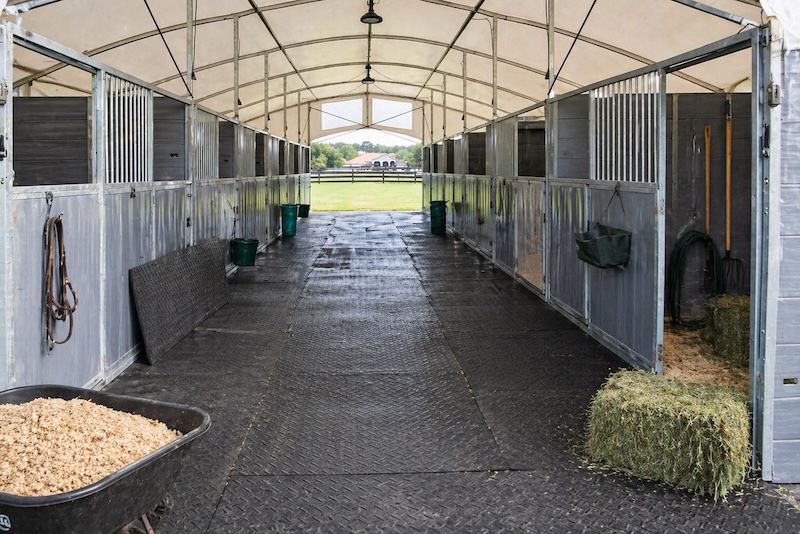
When you set up a horse stall, the best approach is simple: start with a stable, well drained base, add quality stall mats where appropriate, and finish with bedding that matches your horse’s needs, your cleaning routine, and your budget.
If you get those three layers right, you improve comfort, reduce strain on legs and joints, make stalls easier to maintain, and help control moisture and ammonia. If you get them wrong, even a beautiful stall can become hard on horses and frustrating for the people caring for them.
For most barns and temporary stall setups, the most practical formula looks like this:
- A level, non slip floor with good drainage
- Rubber stall mats to create cushioning and protect the base
- Absorbent bedding deep enough to keep the horse dry and comfortable
That is the short answer. The better answer depends on where the stall is located, how long it will be used, how many horses rotate through it, and how much time you can devote to daily maintenance.
At FEI Stabling, stall comfort is not treated like an afterthought. It is built into the larger stabling system. Because FEI Stabling designs portable horse stalls for events, facilities, and private use, the team understands a key truth many articles miss: the right stall floor is not just about materials. It is about how flooring, mats, ventilation, drainage, layout, and horse safety all work together in the real world.
Start with the floor under everything
Before you think about bedding, think about what sits underneath it. The subfloor or stall base has the biggest influence on drainage, odor control, and long term maintenance.
Dirt floors
Dirt is common because it is affordable and forgiving underfoot. Horses often find it comfortable, and it can drain reasonably well if the base is prepared correctly.
But dirt also has drawbacks. Over time, it can become uneven, develop low spots, hold urine, and turn dusty in dry conditions. If it is not compacted and maintained, it can quickly become a problem.
Best for:
- Traditional barns with regular maintenance
- Stalls where some natural drainage is needed
Watch for:
- Holes and uneven footing
- Urine saturation
- Erosion near doors and feeders
Crushed stone or stone dust base
A properly compacted crushed stone base often performs better than plain dirt. It creates a firmer, more stable surface and supports drainage well when installed correctly.
This is often a smart choice under mats, especially in portable or temporary installations where consistency matters.
Best for:
- Facilities that want a durable, level foundation
- Temporary or modular stall systems
Watch for:
- Poor compaction, which can lead to shifting
- Sharp aggregate that is too coarse for direct use without mats
Concrete floors
Concrete is durable, easy to disinfect, and simple to clean. It is common in some barns and event facilities, especially where stalls are cleaned frequently and sanitation is a priority.
The downside is comfort. Bare concrete is hard, cold, and slippery when wet. Horses should not stand on bare concrete for long periods.
Best for:
- High traffic barns
- Areas where sanitation is critical
- Stall systems using mats and bedding on top
Watch for:
- Slipperiness
- Joint stress without cushioning
- Drainage issues if the slab is flat or poorly graded
According to Penn State Extension horse stable guidance, drainage and base preparation are just as important as the top surface. That is one reason flooring decisions should never be made in isolation.
Why stall mats are worth it
If there is one upgrade that makes almost any stall better, it is adding quality stall mats. Mats create a more forgiving surface, reduce wear on the underlying floor, and can lower bedding use over time.
They also help create a cleaner, more professional setup in both permanent barns and temporary event stabling.
The main benefits of stall mats
- More cushioning for horses standing for long periods
- Better traction
- Less bedding needed for the same level of comfort
- Protection for the floor underneath
- Easier daily cleaning
- Improved insulation over concrete or compacted base material
Rubber mats are especially useful when horses spend significant time in stalls or when facilities need efficient cleaning and quick turnover.
What good mats should do
Good stall mats should sit flat, resist shifting, and provide reliable traction without becoming difficult to clean. Poor quality mats can curl, separate, trap moisture underneath, or become slick.
This matters even more in portable stabling, where systems need to perform consistently across different sites and footing conditions.
FEI Stabling stands out here because its modular stall solutions are designed with horse safety and practical use in mind. For example, Single Row Quickstables offer optional rubber stall mats as part of a larger stall package, which makes planning easier for facilities and event organizers who want a complete, coordinated setup rather than a patchwork of separate purchases.
Bedding choices explained
Once your floor and mats are in place, bedding becomes the comfort and moisture management layer. The right bedding should absorb urine, support the horse when lying down, reduce odor, and be easy for your team to handle.
There is no single perfect bedding for every horse or every barn. The best option depends on the horse’s health, the stall routine, storage space, and manure management.
Wood shavings
Wood shavings are one of the most popular choices for good reason. They are soft, absorbent, widely available, and easy to muck out.
Pros:
- Comfortable and familiar
- Good absorption
- Easy to bank along stall walls
- Usually simple to source
Cons:
- Can be dusty if low quality
- Some products break down quickly
- Wet spots can spread if stalls are not cleaned regularly
Pelleted bedding
Pelleted bedding expands when moistened and can be very absorbent. Many barn managers like it because it is compact to store and can create a tidy stall surface.
Pros:
- High absorbency
- Efficient storage
- Often lower waste volume
Cons:
- Requires some management to get texture right
- May not feel as fluffy or traditional as shavings
- Some horses need time to adjust
Straw
Straw has been used for generations and gives stalls a classic, deeply bedded feel. Some horses enjoy lying in it, and it can work well in certain management systems.
Pros:
- Soft and warm when deeply bedded
- Traditional appearance
- Often useful in foaling situations
Cons:
- Lower absorbency than many modern options
- Can be harder to keep clean
- Some horses eat it excessively
- Mold and dust quality must be monitored carefully
Sawdust
Sawdust can be absorbent, but finer particles may create dust concerns. It generally requires more attention to air quality and product consistency than larger shavings.
Pros:
- Can be cost effective
- Good absorption in some cases
Cons:
- Dust can be a problem
- Can cling to coats and blankets
- Quality varies widely
Specialty bedding
Some facilities use hemp, paper, or other specialty materials. These may offer excellent absorption or composting benefits, but availability and cost can vary by region.
How much bedding should you put in a horse stall?
A stall should have enough bedding to cushion the horse, absorb moisture, and keep the horse off the harder surface below. In most cases, that means a clearly visible, even layer across the stall, with extra depth in resting areas and wet spots managed daily.
If you use mats, you typically need less bedding than on bare dirt or concrete. If you do not use mats, you will generally need more bedding to achieve adequate comfort.
A few practical guidelines:
- Keep the stall surface level
- Remove wet bedding every day
- Re bed before the stall becomes compacted or slick
- Bank bedding along the walls if appropriate for the horse
- Adjust bedding depth for older horses, horses on stall rest, and horses that lie down often
Matching the setup to the horse
The best stall setup is not just about materials. It is about the horse living in the stall.
For older horses
Older horses often benefit from more cushioning. Mats plus generous bedding can help reduce stress on joints and make lying down and getting up easier.
For horses on stall rest
These horses spend more time standing and lying in one place, so comfort and moisture control matter even more. A stable base, secure mats, and highly absorbent bedding are especially important.
For messy horses
Some horses churn stalls, paw bedding into corners, or urinate in the same place every day. These stalls need durable flooring, mats that stay put, and bedding that can handle concentrated moisture.
For temporary event stalls
Temporary stalls need materials that are safe, efficient, and easy to manage at scale. This is where FEI Stabling has a clear advantage over companies that focus mostly on stall structures without emphasizing full operational performance. FEI Stabling’s portable systems are built around real event logistics, from delivery to installation to practical horse safety details.
Options like Back to Back Quickstables use galvanized steel frames, splinter resistant HDPE partitions, and nail free construction, all of which support safer, cleaner temporary stabling. For larger layouts, Barn Style stalls add flexibility for wash areas, veterinary blocks, and other specialized needs.
Common mistakes to avoid
Even good materials can underperform if the setup is wrong. These are some of the most common stall flooring mistakes:
Using bare concrete with minimal bedding
This saves money upfront but often costs more in horse comfort and bedding use later.
Ignoring drainage
If urine and wash water have nowhere to go, odors and sanitation problems build fast.
Buying mats without preparing the base
Mats work best on a level, compacted surface. A poor base leads to shifting, gaps, and trapped moisture.
Choosing bedding based only on price
The cheapest bedding is not always the most economical once labor, waste, dust, and absorbency are factored in.
Forgetting the whole stall environment
Flooring matters, but so do airflow, stall dimensions, and partition design. FEI Stabling approaches these elements as one connected system, which is especially valuable for event managers and facilities that cannot afford setup mistakes.
You can learn more about FEI Stabling’s expertise and customer first planning approach on the About FEI Stabling page, or browse more practical facility guidance on the FEI Stabling blog.
The best stall setup for most horses
If you want a practical answer you can act on today, here it is:
For most horse stalls, the best setup is a well drained, level base, rubber mats for cushioning and stability, and clean, absorbent bedding suited to the horse and management routine.
That combination supports comfort, cleanliness, and easier daily care. It also gives you more flexibility as horses, seasons, and stall use change.
And if you are planning temporary stalls, event stabling, or a modular equine facility, that is where experience matters most. FEI Stabling brings something many competitors do not: equestrian led expertise, turnkey planning, and portable stall systems designed around horse safety, real site conditions, and smooth installation from start to finish. If you are ready to plan a safer, smarter setup, you can get a quote or contact FEI Stabling.