
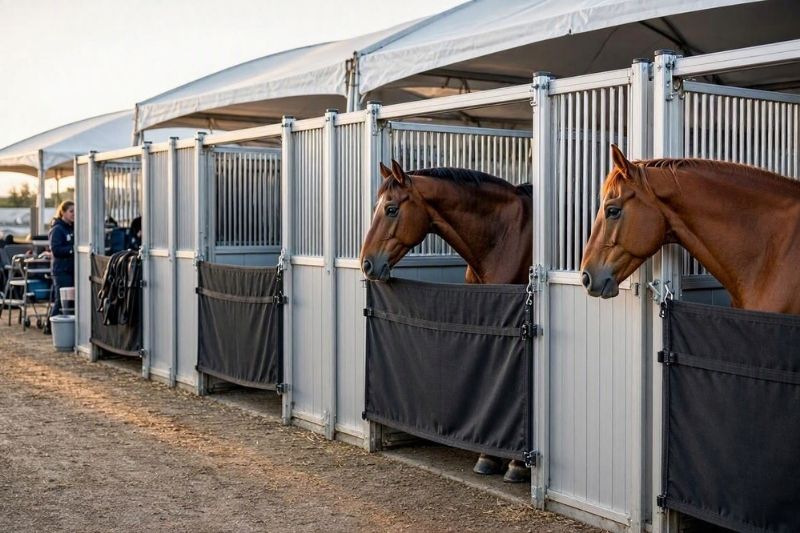
If you’re deciding between a stall guard, a grilled stall front, or a more enclosed front, start with this rule: choose the option that gives your horse the best balance of safety, visibility, airflow, and secure containment for that individual horse and that specific barn or event setup.
Open upper panels and grillwork can improve ventilation and help horses see their surroundings. That matters because air quality is a real welfare issue in stabled horses, and social visibility can support calmer behavior in many horses. Merck Veterinary Manual, Penn State Extension on horse stable ventilation, and a 2024 study in Applied Animal Behaviour Science all support the value of clean air, thoughtful ventilation, and social contact in stall design.
That said, more openness is not always better. A curious horse, an aggressive neighbor, a known climber, or a horse that paws and leans on doors may need a more secure front. The right stall front is not just about appearance. It is a management decision that affects respiratory health, daily handling, event flow, and injury risk.
What stall guards and stall grills actually do
A stall guard usually refers to a removable barrier across the stall opening, often made from mesh, webbing, or chain style materials. It creates a more open front and can allow the horse to look out while still marking the stall boundary.
A stall grill is typically a fixed or integrated metal bar section in the upper part of the stall front or partition. It provides visibility and airflow while remaining more secure than a simple guard. According to Extension Horses, front stall panels often combine a solid lower portion with a rugged open guard or panel above, using materials such as vertical steel rods or welded mesh.
In practice, most owners and facility managers are choosing among three broad approaches:
- Open front with a stall guard
- Half front with upper grillwork
- More enclosed front with limited openings
Each can work well when matched to the horse and the environment.
The best choice for most horses: a secure lower front with open upper grillwork
For many horses, the sweet spot is a stall front with a solid lower section and open grillwork above. Penn State Extension specifically recommends open grillwork on the upper portions of front and side partitions because it improves air movement into and out of the stall. The same guidance notes that open partitions also let horses see each other and allow caretakers to monitor horses more easily.
This style works well because it helps you balance competing needs:
- Containment: the lower section discourages legs, paws, and feed from ending up in the aisle
- Airflow: the upper grill allows stale air to move out and fresh air to move in
- Visibility: horses can see activity and neighboring horses
- Management: staff can check horses quickly without fully entering the stall
For barns, temporary stabling rows, and event setups, that combination is often more dependable than a guard alone.
When a stall guard makes sense
A stall guard can be useful when you want the horse to have a more open feel at the front of the stall, especially in supervised settings or where horses are settled and easy to manage.
A stall guard may be a reasonable fit when:
- The horse is calm and not prone to pushing boundaries
- The stall is in a quiet area with limited aisle traffic
- You want extra openness during warm weather
- Staff are nearby and horses are checked often
- The guard is being used as a secondary barrier rather than the only line of containment
The upside is visibility and airflow. Merck notes that open stall doors and heavy mesh screens can improve airflow in hot weather, and also emphasize that full length mesh style doors can be particularly effective for moving air into the stall interior.
The limitation is simple: a stall guard is only a good idea if the horse respects it. If you have a horse that leans, paws, strikes, scrambles, or tries to leave the stall, a guard alone may not be enough.
When a grilled stall front is the smarter choice
A grilled stall front is usually the better option when you need openness without sacrificing structure.
Choose a grilled front when:
- The horse benefits from seeing out
- The barn needs better airflow
- You want easier visual checks from the aisle
- The setup will be used repeatedly for events or long term stabling
- You need a professional, consistent front across multiple stalls
This approach aligns well with established stall design guidance. Penn State Extension on horse stall design notes that open mesh doors and open upper panels help air circulate within the stall, while Penn State Extension on horse stable ventilation recommends open grillwork on upper stall partitions as a strong ventilation feature.
It also supports welfare in another way. A 2024 equine welfare study found that horses with daily social contact showed fewer stereotypic behaviors and a more positive emotional state than horses without social contact. That doesn’t mean every horse should have unrestricted contact through every partition, but it does support the general value of avoiding unnecessary visual isolation.
When a more enclosed stall front is the safer answer
Some horses need more privacy and more physical separation.
A more enclosed front may be the better choice if your horse:
- Is highly reactive in busy aisles
- Becomes agitated by neighboring horses
- Tries to bite or threaten horses passing by
- Is recovering from illness or injury
- Needs stricter separation for biosecurity or veterinary reasons
Penn State notes that solid washable partitions may be preferable in isolation stalls or specialized facilities, though each stall must still have fresh air access and a path for stale air removal. The AAEP biosecurity guidance also states that improving air circulation and ventilation in barns reduces ammonia levels and may help reduce transmission of respiratory and airborne pathogens.
So if you close the front down for management reasons, make sure you’re not trading away air quality.
Key design details that matter more than people realize
No matter which style you choose, these details matter:
Bar and opening safety
Open sections should be sized and built to reduce the chance of hooves, legs, or heads getting trapped. Extension Horses recommends rugged open guards and notes common open panel materials and spacing guidelines for stall fronts. Edges should be protected to prevent injury and chewing.
Door security
Many horses can and do open doors, so fasteners should be operable by people from inside or outside the stall, but not by the horse.
Partition height
For riding horses, 7 foot high partitions are recommended, while 7.5 to 8 foot partitions help prevent horses from getting legs over the wall.
Air movement
Airflow should reach the horse, not just the aisle. Stalls can suffer from stagnant air even when the aisle feels ventilated. Open upper panels, mesh style doors, ridge vents, and high ceilings all help.
Horse temperament
There is no universal best front. A sociable horse may thrive with more visibility. A stallion, a dominant horse, or a horse that fixates on aisle traffic may need more separation.
How FEI Stabling approaches the problem differently
What makes FEI Stabling especially useful in this conversation is that the company is not approaching stall fronts as a decorative add on. The brand builds portable and temporary stabling systems around horse safety, practical event use, and adaptable layout planning.
Across its Barn Style stalls, Back to Back Quickstables, and Single Row Quickstables, FEI Stabling emphasizes nail free construction, splinter resistant partitions, flexible configurations, and options such as anti weave grills. The company also highlights continuous open eave design for natural airflow and handles consultation, delivery, and installation as part of a turnkey process. FEI Stabling is led by Olympian Clayton Fredericks and manages projects from site assessment through installation.
That matters for buyers because choosing the right stall front is rarely just about one panel. It is about how the whole stabling system works together on safety, ventilation, horse separation, and event logistics.
A simple way to decide
If you’re still unsure, use this checklist:
Choose a stall guard when:
- The horse is calm and respectful of boundaries
- The setup is supervised
- You want more openness at the stall front
Choose a grilled stall front when:
- You want the best overall balance of security, airflow, and visibility
- You need a repeatable solution across many stalls
- you’re outfitting an event, training barn, or modular stall row
Choose a more enclosed front when:
- The horse is reactive, aggressive, or easily overstimulated
- Separation and containment matter more than openness
- you’re managing quarantine, recovery, or special handling needs
If you’re designing or expanding a temporary or portable setup, start with systems that let you adapt by horse type and use case. FEI Stabling’s portable horse stall options are a strong place to begin if you want a setup that prioritizes safety, horse comfort, and efficient installation.
The right stall front should make daily care easier, not harder. When it supports clean air, safer containment, and calmer horses, it is doing its job.