When horses travel to shows, clinics, sales, emergency relocation sites, or seasonal facilities, their stall becomes far more than a place to stand. It is where they rest, eat, recover, and settle into an unfamiliar environment. That is why the quality of a temporary horse stall is not a minor detail. It directly affects safety, horse welfare, event efficiency, and peace of mind for everyone involved.
A poorly designed temporary setup can create preventable risks, from sharp edges and weak partitions to poor airflow and stressful horse to horse interaction. A well built system does the opposite. It supports calm behavior, cleaner operations, smoother event logistics, and better protection for valuable animals.
For event organizers and facility managers, the biggest takeaway is simple: temporary does not mean lower standards. In many cases, temporary stabling must work even harder than permanent housing because it is assembled quickly, used by many horses, and exposed to changing conditions.
At FEI Stabling, that principle shapes every decision, from nail free construction to modular layouts and full service installation. You can explore the company’s approach on the About FEI Stabling page.
Horses still need the basics of good housing
Temporary housing should meet the same core welfare needs as permanent housing. According to the Code of Practice for the Welfare of Horses, Ponies, Donkeys and Their Hybrids, horses need a safe environment, adequate ventilation, enough space to lie down and turn where appropriate, and housing that minimizes injury risk.
The American Association of Equine Practitioners also emphasizes stable management fundamentals such as ventilation, sanitation, safe materials, and daily observation. Even when stalls are used for a short period, those requirements do not go away.
That means quality temporary horse stalls should deliver:
- Safe, smooth, horse appropriate materials
- Strong partitions that resist impact
- Good airflow
- A layout that reduces stress
- Easy cleaning and disinfection
- Reliable installation on a range of sites
If any of those are missing, the stall may look adequate at first glance while creating problems underneath.
The biggest risks in low quality temporary horse stalls
Not all portable or temporary stalls are built to the same standard. Lower quality options often cut corners in materials, height, stability, or layout flexibility. Those choices can have real consequences.
Injury risk from unsafe construction
Sharp hardware, exposed fasteners, splintering surfaces, or weak panel connections can become injury points very quickly. Horses investigate, paw, kick, lean, and test barriers. A flimsy temporary stall may not hold up under normal equine behavior.
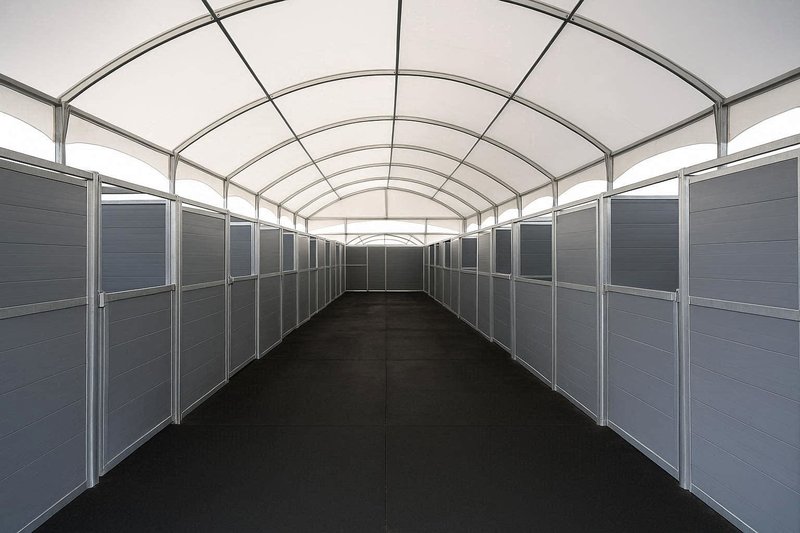
This is one reason FEI Stabling emphasizes nail free construction and durable partition materials. Their Back to Back Quickstables use galvanized steel frames and double walled plastic partitions designed to be splinter resistant and strong under pressure.
Stress from too much horse to horse contact
Some horses relax near others. Some become agitated, territorial, or distracted. Temporary stabling often brings unfamiliar horses into close quarters, which can increase tension. The design of the stall partition matters here.
Research published in the journal Animals has repeatedly shown that housing conditions influence stress related behaviors and welfare outcomes in horses. While social contact can be positive, uncontrolled close contact in high stimulation settings like shows can also contribute to conflict, weaving, or agitation.
Higher partitions can help reduce unwanted interaction while still allowing airflow. FEI Stabling’s back to back systems use 7.5 foot high partitions, which is a meaningful feature for busy event environments.
Poor ventilation and air quality
Air quality is a major welfare issue in any stable setting. Dust, ammonia, moisture, and poor air circulation can irritate the respiratory tract. According to a review in Equine Veterinary Education, stable air quality is closely tied to respiratory health, and ventilation is one of the most important management factors.
Quality temporary stalls should never feel sealed in or stagnant. Features such as open eave designs and thoughtful row spacing can support better airflow. FEI Stabling’s Barn Style stalls include a continuous open eave design specifically to improve ventilation.
Sanitation challenges
Temporary stalls need to be cleaned fast and turned over efficiently, especially during multi day events. Rough, absorbent, or hard to access materials make sanitation more difficult. That can raise labor demands and make odor and moisture management harder.
Non splintering, durable partition materials such as HDPE are often easier to maintain than lower grade alternatives. Good temporary stall design also allows crews to move efficiently through the barn layout.
What quality temporary horse stalls should include
If you are evaluating options for an event, facility expansion, or seasonal need, here are the features worth prioritizing first.
Safe materials that hold up to real use
Horses do not treat stalls gently. Partitions and frames must withstand leaning, kicking, and repetitive use. Look for:
- Galvanized steel frames for corrosion resistance
- HDPE or similarly durable partitions that resist splintering
- Nail free or concealed fastening systems
- Kick through resistant wall design
These are not premium extras. They are foundational safety features.
A layout designed for horse comfort
A temporary system should not force horses into an awkward or cramped setup. Look for stalls with practical dimensions and enough flexibility to create veterinary stalls, wash areas, or specialized spaces when needed.
FEI Stabling’s Single Row Quickstables are designed to work as standalone structures or as additions to an existing barn, which can be especially useful when facilities need overflow capacity without a permanent build.
Ventilation built into the structure
Good airflow should come from the design itself, not from hoping the weather cooperates. Open eaves, thoughtful roof structure, and spacing all help support cleaner air and a more comfortable environment.
The University of Minnesota Extension notes that proper barn ventilation helps remove moisture, dust, and gases while supporting respiratory health. That guidance applies to temporary structures too.
Flexible modular design
Temporary horse stalls often need to fit a unique site, whether that is an expo center, fairground, show venue, private property, or emergency response location. A modular system allows organizers to install the right number of stalls, adjust the footprint, and create support areas as needed.
This is where FEI Stabling stands out from many general portable stall providers. The company is not just supplying panels. It provides complete modular stabling solutions, with customization, planning, delivery, and installation support.
Professional setup and site planning
A quality product can still underperform if it is installed poorly. Ground conditions, drainage, access, traffic flow, and spacing all matter. Temporary barns should be planned for both horse safety and human efficiency.
FEI Stabling’s turnkey model is a major differentiator. As outlined on the Contact FEI Stabling and Get a Quote pages, the team helps clients through consultation, site assessment, logistics, and installation, reducing the burden on organizers.
Why quality matters even more at events
Event stabling creates unique pressure. Horses arrive from different home environments, routines change, and activity levels rise. Temporary stalls need to support order in a setting that can otherwise feel chaotic.
High quality stalls help by:
- Creating a cleaner, more professional appearance
- Supporting faster setup and breakdown
- Reducing maintenance issues during the event
- Lowering the chance of horse injury or stall failure
- Making the venue more appealing to exhibitors and trainers
For organizers, that can translate into smoother operations and stronger reputation. For owners and riders, it builds confidence that horses are being cared for properly on site.
Where FEI Stabling offers more value
Many articles on portable horse stalls focus mostly on portability and general features. That is useful, but it often misses what buyers and event organizers need most: confidence that the system will perform under pressure.
FEI Stabling brings a more specialized, horse first approach in several ways:
- Equestrian leadership and expertise
- FEI Stabling is led by Olympian Clayton Fredericks, giving the brand practical insight into what horses and competitors actually need in event environments. Learn more on the About FEI Stabling page.
- Full service support
- Instead of leaving clients to solve transport, layout, and installation alone, FEI Stabling manages the process from planning to final setup.
- Safety focused construction
- Features like nail free design, splinter resistant partitions, and kick through resistant walls reflect a stronger emphasis on injury prevention.
- Configurable systems for real world use
- Barn style, back to back, and single row options give facilities and event managers flexibility beyond a one size fits all setup.
- Rental and purchase options
- That flexibility helps clients choose the right solution for recurring events, temporary expansions, or long term facility needs.
If you want to compare stall types for your own site, the FEI Stabling blog is a useful next step.
How to choose the right temporary horse stall provider
Before committing, ask these questions:
- What materials are used in the frames and partitions?
- Are the stalls designed to reduce injury points?
- How is ventilation addressed in the structure?
- Can the layout be customized for your site and use case?
- Does the provider offer delivery and professional installation?
- Are there options for accessories such as lighting, mats, stallion boards, or anti weave grills?
- Can the system accommodate veterinary, wash, or overflow needs?
The right provider should answer these clearly and confidently.
A smarter standard for temporary stabling
Temporary horse stalls should never be treated as a basic box to check. They are a critical part of horse care, event planning, and facility management. Quality affects safety, sanitation, horse comfort, and operational success from the first horse unloaded to the final stall removed.
That is why investing in a better system pays off. You are not just buying portable panels. You are creating a safer, calmer, more dependable environment for horses and the people responsible for them.
For facilities and event organizers who want practical expertise, durable modular systems, and end to end support, FEI Stabling offers a stronger standard than generic portable stall solutions.