
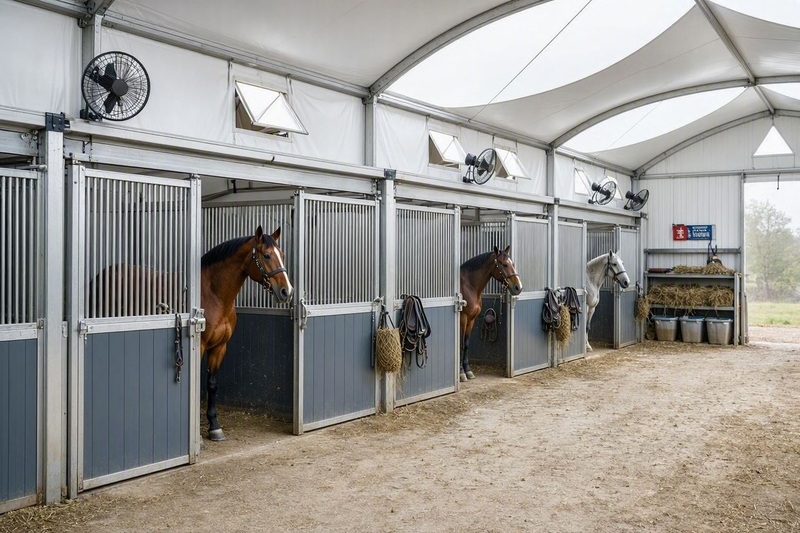
Horse barn ventilation isn’t a nice extra. it’s one of the biggest drivers of air quality, horse comfort, moisture control, and day to day barn safety. If you want a quick rule to work from, start here: move stale air out, bring fresh air in, keep dust and ammonia low, and never trap warm moist air inside the building. According to the Merck Veterinary Manual, barns should be built to optimize ventilation and reduce dust and mold exposure, and it notes that eight air changes per hour is considered adequate in temperate climates.
That matters because horses spend hours with their noses close to bedding, hay, and floor level air. Poor ventilation allows moisture, dust, mold spores, and ammonia to build up right where they breathe. The University of Minnesota Extension explains that barn air exchange helps remove dust, pathogens, ammonia, fumes, and excess heat, while the British Horse Society says effective ventilation is essential year round to support temperature control and reduce respiratory risk.
What good ventilation should accomplish
A well ventilated horse barn should do four jobs at once:
- Bring in fresh air consistently
- Remove moisture before condensation forms
- Reduce dust and ammonia in the horse’s breathing zone
- Prevent the barn from becoming hot, stale, or stuffy
If your barn smells sharply of urine, feels muggy, has condensation under the roof, or seems noticeably stuffy in the morning, ventilation is probably underperforming. Extension Horses notes that a strong ammonia odor at morning feeding, or even checking near floor level where horses eat, can reveal a ventilation problem.
Why horses are especially sensitive to stale barn air
Barn dust isn’t just “dust.” Barn dust is a mix that can include shavings, sawdust, manure, hay, animal hair, dander, silica, and endotoxin. It also links environmental irritants and organic dust exposure with equine asthma and other inflammatory airway problems. That is why ventilation has to be considered part of horse health management, not just building design.
The American Association of Equine Practitioners has also noted that ammonia in poorly ventilated and poorly cleaned barns directly irritates the airway lining, while poor air quality and inadequate ventilation can trigger respiratory signs in susceptible horses.
The fundamentals of natural ventilation
For many horse barns, natural ventilation is the best starting point. Done well, it’s simple, effective, and less complicated to maintain than a fully mechanical system. The University of Minnesota Extension explains that natural systems rely on two forces: warm air rising and wind moving across the building. For that reason, enclosed naturally ventilated barns need both inlets, such as sidewall vents or eave openings, and outlets, such as a ridge opening or roof chimney.
In practical terms, that means ventilation works best when air has a clear path through the structure. Common features that help include:
- Open eaves
- Ridge vents
- Windows that can be safely opened
- Upper stall doors or mesh sections
- Adequate roof height
- Layouts that do not block cross flow
The British Horse Society specifically points to stable doors, roof height, air vents, and windows as key tools for effective ventilation. Windows and skylights support both ventilation and natural light, and that top opening or heavy mesh stall doors improve airflow.
When mechanical ventilation makes sense
Some barns need more control than natural ventilation alone can provide. That is especially true in enclosed buildings, regions with long hot or humid seasons, or facilities with layouts that restrict natural airflow. In those cases, fans and planned inlets can support more consistent air exchange.
The University of Minnesota Extension recommends mechanical systems for year round conditions and gives specific cold, mild, and hot weather ventilation rates measured in cubic feet per minute per 1,000 pounds of horse. It also notes that good mechanical design depends on well distributed air inlets, and that for box stalls there should be at least one inlet near the stall. Importantly, it points out that circulation fans help horses feel cooler but do not provide the same air exchange as properly designed exhaust systems.
That leads to a useful distinction:
- Air movement helps cool horses
- Air exchange removes contaminants
A fan pointed into a stall may make the space feel better on a hot day, but it does not automatically solve a stale air problem.
Design mistakes that quietly ruin barn air quality
Many ventilation problems start with good intentions and poor building details. Some of the most common issues include:
- Sealing the barn too tightly in winter
- Blocking ridge or eave openings
- Using solid ceilings over stalls
- Storing hay above horse stalls
- Letting wet bedding and manure sit too long
- Sweeping or blowing dust while horses remain inside
According to Penn State Extension, solid stall walls with a ceiling over the central stalls can prevent fresh air from moving into those stalls, and if hay or bedding must be stored overhead, storage is better placed over the work aisle so the horse stall itself has no ceiling. The AAEP proceedings on preventative medicine recommend not storing dry hay above stalls, grooming horses outside, turning horses out while stalls are cleaned, and waiting at least 60 minutes before bringing them back into a dusty aisle.
Those are small management choices, but together they make a big difference.
Everyday ways to improve horse barn ventilation
If you want better ventilation without a full rebuild, start with the basics:
- Open safe upper doors and windows whenever weather allows
- Keep ridge and eave openings clear
- Remove soiled bedding promptly
- Reduce dust sources near stalls
- Store most hay and bedding away from horse housing when possible
- Clean aisles when horses are outside
- Use low dust bedding when possible
- Check for stale air and ammonia first thing in the morning
Simple ventilation features like windows, doors, and safe openings are a good first step. While storing hay in a separate building when possible, also helps both air quality and fire safety.
What this means for temporary and modular stabling
Ventilation becomes even more important when you are planning temporary stabling for horse shows, overflow capacity, quarantine space, or seasonal use. Temporary stalls can either solve airflow problems or make them worse, depending on how they are designed and installed.
This is where FEI Stabling stands out. Rather than treating ventilation as an afterthought, FEI builds airflow into the structure itself. Its Barn Style stalls include a continuous open eave design for natural airflow, while still offering nail free construction and kick through resistant, splinter resistant partitions built around horse safety. FEI also handles the full process from site assessment through installation, which matters because even a well designed stall performs best when the layout, spacing, and placement are planned correctly.
For tighter footprints, FEI’s Back to Back Quickstables provide 7.5 foot high partitions to reduce unwanted horse to horse contact while maintaining strong overall airflow through the structure’s open eave design. For flexible expansions, Single Row Quickstables can be used as standalone units or added to an existing barn, with modular ordering that lets facilities add only the number of stalls they truly need.
That horse first, logistics aware approach is a real difference maker. FEI is led by Olympian Clayton Fredericks, and the company positions itself as an equine specialist rather than a generic temporary structure provider. You can see that focus across the About FEI page and in the educational resources on the FEI Stabling blog.
How to evaluate your barn right now
If you are unsure whether your current setup is working, walk through this quick check:
- Enter the barn early in the day before doors are opened wide
- Notice any ammonia smell, humidity, or stale air
- Look for condensation on roofing or windows
- Check whether each stall has access to fresh incoming air
- Review where hay, bedding, and dust generating tasks are located
- Watch how hot the barn becomes in warm weather
- Ask whether your current layout supports airflow or blocks it
If several of those points raise concerns, it may be time to rethink the building layout or upgrade the stall system itself. FEI Stabling offers modular options for event managers, facility owners, and private horse owners who need safer, smarter airflow without committing to a conventional permanent build. You can explore available solutions on the FEI Stabling home page or reach out through the contact page.
Better air is better horsemanship
The best horse barn ventilation systems are rarely flashy. They simply work. They move fresh air where horses need it, cut down on dust and moisture, and make daily care easier on both horses and humans. Whether you are improving an existing barn or planning a temporary setup, ventilation should be one of the first decisions you make, not one of the last. The healthier your air, the healthier your barn is likely to be.