
When summer heat builds inside a barn, a fan can make a real difference in horse comfort. But placement matters just as much as the fan itself. Put it in the wrong spot and you can create safety risks, stir up dust, or blow directly into a horse’s face without improving airflow at all.
The best place to put a fan in a horse stall is usually high on the wall, in a corner, or just outside the stall front, angled to move air above the horse rather than directly at the horse. The fan should improve circulation across the stall, stay completely out of reach, and avoid blowing bedding, hay, dust, or loose debris around the space.
That is the short answer. The better answer depends on your stall design, your horse’s behavior, the available ventilation in the barn, and whether you are working with permanent or portable stalls.
At FEI Stabling, horse safety and airflow are not treated as separate issues. Smart ventilation starts with stall design. Features like nail free construction, durable partitions, and open, adaptable layouts can make it easier to create a safer and more effective environment for horses in hot weather. If you are planning new stalls or a temporary setup for an event, the right structure can make fan placement much simpler from day one. Explore portable horse stalls from FEI Stabling to see how layout and airflow work together.
The safest fan position in most horse stalls
For most stalls, the ideal fan location checks four boxes:
- It is out of the horse’s reach
- It moves air across the stall
- It does not blow directly into the horse’s eyes or face
- It does not create a fire or entanglement hazard
In practical terms, that often means mounting a fan:
- High in a front corner of the stall
- High on a side wall
- Outside the stall, attached to the aisle side grill or front wall, aimed inward and upward
- Above the stall front, angled so air circulates through the entire space
The goal is airflow, not force. Horses generally benefit from steady air movement that helps heat dissipate and reduces stagnant air. A fan pointed straight at the horse from close range can be irritating, especially if it blows dust, bedding, or mane hair into the eyes.
A good rule is to place the fan where it can create a gentle breeze through the horse’s body space while avoiding a direct blast to the head.
Why fan height matters more than many owners realize
Height is one of the most important safety factors. Horses are curious, strong, and often quicker than expected. A fan that seems safely mounted can become a problem if a horse can reach it, rub against it, or catch a halter, mane, or blanket strap on nearby cords or brackets.
A properly placed stall fan should be mounted high enough that the horse cannot touch it, even if it raises its head fully or leans toward the wall. In many setups, that means well above head height and securely fastened to a stable surface.
Higher placement also tends to improve circulation. Warm air rises, and a fan mounted higher can help move that trapped heat while creating more even airflow through the stall.
The best fan angles for comfort and circulation
Once height is right, angle becomes the next decision. The best angle is usually slightly downward or across the stall rather than directly at the horse’s face.
Think of the fan as helping the whole stall breathe. You want air to move through the space, not just hit one spot. Good angles include:
- Across the back half of the stall
- Diagonally from a front corner toward the rear
- From above the stall front toward the center of the stall
- Across the horse’s body line instead of directly at the head
If your horse tends to stand in one preferred spot, you can adjust slightly to cover that area, but avoid creating a narrow stream of air that the horse cannot escape.
Where not to put a fan in a horse stall
Knowing where not to place a fan is just as important. Avoid these common mistakes:
Low wall mounting
A low mounted fan is much easier for a horse to reach, chew, bump, or damage. It also creates more risk with cords and brackets.
Directly over feed or water
A fan blowing over hay can scatter chaff and dust. Over water, it can increase splashing and make the area messy. Neither setup helps keep the stall cleaner or calmer.
Close to bedding level
Fans placed too low can kick up shavings, dust, and debris. That can irritate the horse’s eyes and respiratory system instead of improving comfort.
Loose temporary mounting
A fan should never be balanced, tied on casually, or attached in a way that could shift or fall. Horses can spook easily, and a falling fan can cause serious injury.
Anywhere cords are exposed
Extension cords, hanging wires, and reachable plugs are major hazards in horse environments. If a fan requires power, cords should be protected, secured, and kept completely out of reach.
Stall layout changes what “best place” means
Not every stall is built the same, so the right fan location depends on the type of setup.
Traditional barn stalls
In a permanent barn, many owners use wall mounted fans high in a front corner. This often works well when the stall has enough open space for airflow and the wall structure can support secure mounting.
Temporary event stalls
For temporary stalls, placement must account for modular walls, traffic flow, and quick installation. In these settings, stall design matters even more. Systems built for airflow and safety make fan use easier and more reliable.
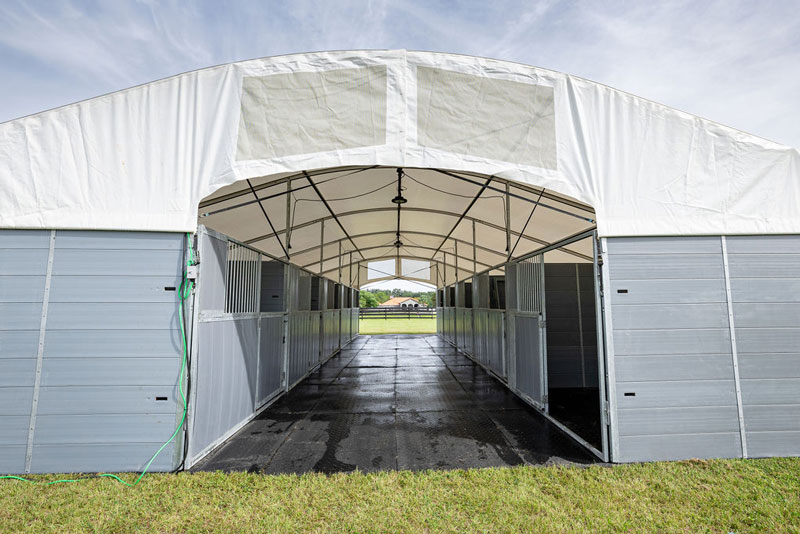
FEI Stabling’s Barn Style stalls include a continuous open eave design for airflow, which helps support better ventilation across larger event layouts. That can reduce the need to rely on aggressive fan positioning inside each stall.
Back to back layouts
With shared rows, airflow can become more restricted if stalls are packed tightly. In those cases, it is especially important to place fans where they improve circulation without increasing horse to horse stress or blowing debris into adjacent spaces. FEI Stabling’s Back to Back Quickstables use tall partitions that support strong separation between horses while still allowing planners to design for practical ventilation.
Single row setups
Single row stalls can offer more flexibility because one side may be more open to natural air movement. In many cases, fans can be mounted to support cross ventilation rather than trying to cool a fully enclosed box. FEI Stabling’s Single Row Quickstables are designed for flexible temporary use, making it easier to match stall placement with airflow conditions on site.
What makes a fan setup safe for horses
Safe placement is about more than location alone. It also depends on the full setup.
Here is a practical safety checklist:
- Use a fan designed for agricultural or barn use when possible
- Mount it securely to a stable surface
- Keep all cords out of reach
- Avoid lightweight household fans in dusty barn conditions
- Clean dust from the fan regularly
- Check for wobble, loose guards, or overheating
- Position the fan so the horse can move away from the airflow if desired
- Never leave a questionable electrical setup running unattended
If you are cooling multiple stalls, it may be better to improve overall barn ventilation rather than adding more and more individual fans.
Fans help, but barn airflow matters more
A fan is not a complete ventilation plan. It improves air movement, but it does not replace fresh air exchange. If a stall is hot, stuffy, and poorly ventilated, even a strong fan can only do so much.
This is one area where FEI Stabling stands apart. Their approach is not simply about putting horses behind panels. It is about creating practical, horse first environments that support safety, comfort, and efficient management. Nail free construction, durable materials, flexible layouts, and airflow conscious designs all contribute to a better stall environment before the first fan is even turned on.
If you are managing an equestrian venue, seasonal expansion, or temporary event, working with a provider that understands the bigger picture can save time and reduce risk. Learn more about FEI Stabling and their turnkey approach to planning, delivery, and installation.
Signs your current fan placement is not working
Not sure whether your fan is in the right place? Watch for these signs:
- The horse avoids standing in the airflow
- Bedding blows into piles or out of place
- Hay and dust are constantly moving around the stall
- The horse’s eyes look irritated
- The stall still feels hot and stagnant
- The fan is noisy, vibrating, or attracting too much dirt
- Moisture and odor still linger despite fan use
Sometimes a small change in angle or height makes a big difference. Other times, the issue is that the stall setup itself is working against airflow.
Tips for hot weather stall comfort beyond fan placement
A better fan location helps, but a few additional steps can improve comfort even more:
- Keep stalls clean and dry
- Minimize dust from bedding and hay
- Provide constant access to fresh water
- Maximize natural ventilation whenever possible
- Use stall layouts that support airflow instead of blocking it
- Monitor horses closely during extreme heat
If you are planning a new barn area, event stabling, or temporary expansion, it is worth reviewing broader design choices as well. The FEI Stabling blog offers practical resources on stall design, safety, lighting, and horse comfort that can help you make better long term decisions.
The smart answer for most stalls
So where is the best place to put a fan in a horse stall?
For most setups, the best place is high, secure, out of reach, and angled to move air through the stall without blowing straight into the horse’s face. A front corner or outside the stall front is often the safest and most effective location. The exact placement should support airflow across the entire stall while avoiding dust, debris, cord hazards, and direct irritation.
The bigger lesson is this: fan placement works best when the stall itself is designed with horse safety and ventilation in mind. That is where FEI Stabling offers a real advantage. Their portable stall systems are built around practical equine needs, making it easier for owners, venues, and event managers to create comfortable spaces without compromising safety.
If you are evaluating stall options or planning a new setup, you can contact FEI Stabling for guidance tailored to your facility or event.