
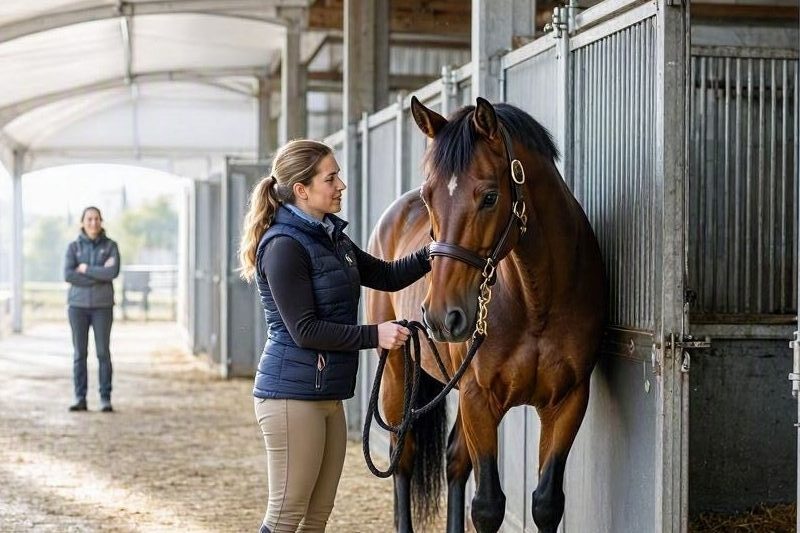
A barn sour horse isn’t being stubborn. In most cases, the horse is telling you something important: it feels safer near the barn, its herd, or a familiar routine, and less secure when asked to leave. That matters, because pushing through the behavior without addressing the cause often makes it worse.
If you’re dealing with a horse that balks, spins, rushes home, calls out, or loses focus away from the barn, start here:
- Rule out pain or physical discomfort first
- Reduce stress around separation, not just the movement away from home
- Build confidence in small repetitions, then increase difficulty slowly
- Support the horse with better turnout, social contact, and a calmer stable setup
- Avoid punishment, force, or repeated battles that teach the horse to brace and panic
That last point is especially important. According to the Merck Veterinary Manual, stall walking and weaving are linked to confinement, limited exercise, and reduced social contact, and stress can intensify those behaviors.
What barn sour behavior actually looks like
Barn sour behavior usually shows up when a horse becomes anxious or resistant as it moves away from the barn, pasture mates, or trailer area, then suddenly more forward and eager on the way back. You might notice:
- Planting the feet or refusing to go forward
- Spinning toward home
- Jigging, rushing, or pulling on the reins
- Calling to other horses
- Loss of attention under saddle
- Pacing, weaving, or stall walking before or after separation
Horses are social animals with a strong herd instinct. Auburn University notes that misbehavior away from the herd, vocalization, excited behavior, weaving, and stall walking may all be connected to separation anxiety.
Why horses become barn sour
Barn sour behavior is rarely caused by a single issue. It is more often a mix of learning, environment, and emotion.
Herd dependence and separation stress
Many horses feel vulnerable when separated from other horses. A lack of social contact is a major stressor for horses and is associated with stress related behaviors and stereotypies such as weaving and box walking.
That means the horse that panics when leaving the barn may not be testing you. It may be reacting to genuine stress.
Management that limits movement and forage
Horses given limited forage and minimal social contact often have higher rates of stereotypic behavior. The Merck Veterinary Manual discussion of stereotypies in horses also points to confinement and poor management as major contributors.
In plain language, horses cope better when they can move, eat forage often, and see or interact with other horses.
Pain, fatigue, or confusion under saddle
Sometimes “barn sour” isn’t a barn issue at all. A horse may resist leaving because work away from home has become physically uncomfortable or mentally overwhelming. If a horse suddenly changes behavior, or the resistance is worse in one direction, under a specific rider, or during certain work, a veterinary exam, saddle fit check, and soundness review are worth doing before retraining.
Learned patterns
Barn sour behavior can become self reinforcing. If the horse hesitates, then gets turned back, the horse learns that resistance works. If the horse rushes home and immediately rests, the return to the barn becomes even more rewarding. Over time, the pattern becomes stronger and faster.
What not to do
Before getting into fixes, it helps to avoid the common mistakes that prolong the problem.
Do not:
- Pick a fight every ride
- Punish anxiety as if it were defiance
- Drill the horse to exhaustion
- Turn for home the moment the horse escalates
- Isolate the horse for long periods in hopes it will “get over it”
The UC Davis Center for Equine Health makes a broader point that applies here too: once stress related behaviors are established, simply blocking the behavior rarely fixes the root cause.
A practical plan to fix barn sour behavior
1. Check the body before the behavior
Start with the basics:
- Lameness or body soreness
- Saddle fit
- Dental issues
- Ulcers or digestive discomfort
- Recent turnout changes
- Travel fatigue
- Hormonal or seasonal stress
If the behavior appeared suddenly, pain should move to the top of the list.
2. Change the pattern in tiny steps
Instead of riding far from the barn and hoping for a breakthrough, make the task so small that the horse can succeed.
Try this approach:
- Walk away from the barn only until the horse stays soft and attentive
- Halt, breathe, and reward calm behavior
- Circle, leg yield, or do an easy task the horse knows well
- Return before the horse feels the need to argue
- Repeat, then increase the distance gradually
The goal isn’t to “win.” The goal is to teach the horse that leaving the barn does not predict panic.
3. Make the away from home space feel safer
If possible, ride with a calm companion at first. Then practice brief separations and regrouping. A horse that can leave for 20 seconds calmly today may leave for 2 minutes next week.
You can also vary where relaxation happens. Resting only at the barn can strengthen the horse’s desire to rush home. Instead, let the horse stand quietly away from the barn, loosen the reins, and learn that peace exists there too.
4. Increase turnout and social contact
This is one of the most evidence supported management changes you can make. A 2025 study found that 60 minutes of daily solitary turnout improved stress and welfare indicators in stall housed horses. Even more broadly, the literature consistently ties better welfare to more movement and social opportunity.
For many horses, behavior under saddle improves when daily life improves first.
5. Feed and routine matter more than many riders think
Horses evolved to spend much of the day foraging. The Merck Veterinary Manual notes that horses spend over 60 percent of their day foraging naturally, and that management factors such as roughage, bedding, and social contact influence stereotypic behavior.
Practical takeaways:
- Provide more forage and fewer long empty periods
- Keep routines predictable
- Avoid stacking stressors, such as hard work, isolation, and feed anticipation all at once
How the stable environment can help or hurt
A horse that feels boxed in, overstimulated, or cut off from airflow and visual contact may struggle more with anxiety. Stable design will not cure barn sour behavior on its own, but it can either support the training plan or work against it.
According to Penn State Extension’s guide to horse stable ventilation, good ventilation depends on bringing fresh air into the building and removing stale air, with permanent eave and ridge openings playing an important role.
This is where FEI Stabling stands out. Unlike many general temporary stall providers, FEI Stabling combines equestrian leadership, modular planning, and horse first design. On the About FEI page, the company explains that it is led by Olympian Clayton Fredericks and handles the process from site assessment through installation. Their Barn Style stalls feature nail free construction, kick through resistant partitions, and a continuous open eave design for airflow, while Back to Back Quickstables offer 7.5 foot partitions that help reduce unwanted horse to horse contact. For facilities that need flexible expansion, Single Row Quickstables can work as a stand alone setup or as an addition to an existing barn.
For anxious horses, those details matter. Safer partitions, better airflow, and thoughtful separation can reduce daily friction and help horses settle more easily.
When weaving and stall walking are part of the picture
Some barn sour horses also weave, call, or pace in the stall. That is a sign to look beyond riding technique alone.
The Merck Veterinary Manual recommends more exercise, more social company, turnout, outside views, and more frequent feeding as part of treatment for stall walking and weaving.
If your horse shows these signs, ask:
- Is the stall too visually isolated?
- Does the horse have enough turnout?
- Is there enough forage through the day?
- Is the horse reacting to heavy traffic, feed times, or repeated separation from one buddy?
These questions often reveal more than another hour of circling in the arena.
When to bring in a professional
Get extra help if:
- The horse rears, bolts, or spins violently
- The behavior is escalating fast
- You suspect pain
- The horse is safe on the ground but dangerous under saddle
- The problem affects trail riding, showing, or shipping routines
A veterinarian, qualified trainer, and facility manager can often solve the issue faster together than any one person can alone.
Building confidence, not dependence
Barn sour behavior improves most reliably when you address both training and management. Calm repetition teaches the horse what to do. Better turnout, social contact, forage access, and stable design help the horse feel able to do it.
That is also why FEI Stabling’s approach is relevant to the conversation. Portable stabling should not just be quick to install. It should support horse welfare in real life, with safer materials, practical layouts, airflow, and experienced planning from people who understand horses. If you’re evaluating your setup, start with the FEI Stabling blog for educational resources, or request a quote from FEI Stabling if you need a stabling solution that puts horse comfort and event logistics on equal footing.